


When I was in primary school, my teacher often tried to introduce wellness tips into the classroom. We would regularly stand up and move around to improve our circulation, and practised nasal breathing to de-stress.
I quite enjoyed it. But I remember one piece of advice being very confusing. It was about the nervous system and how to use deep breathing to manage stress.
“Please all stand up and start breathing through your belly,” the teacher announced. “This will help your body relax.”
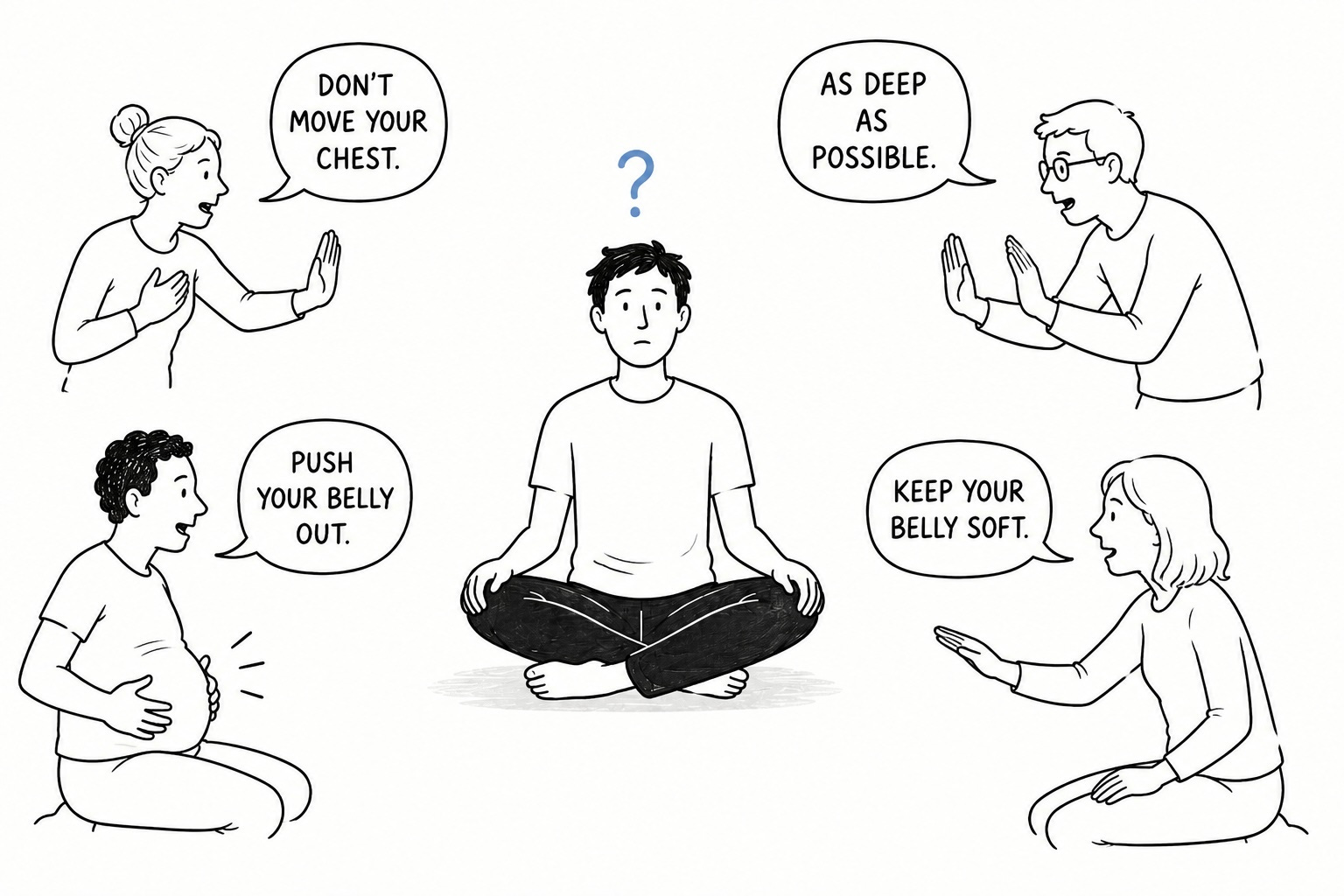
Breathe through my belly? I thought. She must be confused. I had only just learned about breathing through my nose, so belly breathing was kind of new. It’s possible the teacher noticed my confused face, because she started clarifying further.
“Avoid breathing through your chest and just expand your belly.”
This clarification did not help at all.
I wanted to learn this special technique. Various thoughts crossed my mind. This is important. I don’t want to be a stresshead but… how da flip am I supposed to breathe through my belly button?
I looked around and I wasn’t the only one confused. All my friends were tensing up and twisting their bodies as if they were in a belly dancing competition!
I joined in, pushing my belly in and out. It kind of hurt, but If it was meant to relax me, then it’s worth giving it a go, I thought.
So I continued doing what I now know would probably class as breath holding with intermittent tensing of my abs. By the end of it, I felt a little demoralised. I was in pain and there was no sign of the promised relaxation.
It’s funny to remember my thoughts then. Now, I know much more about breathing, but I think it’s useful to reflect on what happened. Many people will relate to the confusion of unclear breathwork instructions. I think a milder version of this story happens every day all over the world.
Yoga teachers, therapists, personal trainers, and even breathwork instructors repeat the phrase “belly breathing” or “diaphragmatic breathing”. I think their intentions are usually good. But without sufficient anatomical explanation, it’s easy for things to go wrong - probably not as far as my idea of inhaling through the belly button when I was 7, but still wrong.
In this guide, I will use my experience as a therapist and years of personal practice in breathwork to break it down step-by-step.
Diaphragmatic breathing made simple. Let’s try.
If at any point it feels too complicated, it means I failed at keeping it simple. Sorry! But don’t worry, I will provide a summary at the end. Feel free to jump straight there if you’re short on time.
The diaphragm
The more you hear a word, the more familiar it feels. But this wasn’t the case for me with the word diaphragm.
When I was a novice therapist, I signed up for a mindfulness instructor course. Even then, I was confused by what a diaphragm is. I couldn’t feel it. I couldn’t see it. I had no idea how to use it, but I was constantly being told to use it. What’s worse, I was being told to tell other people to use it.
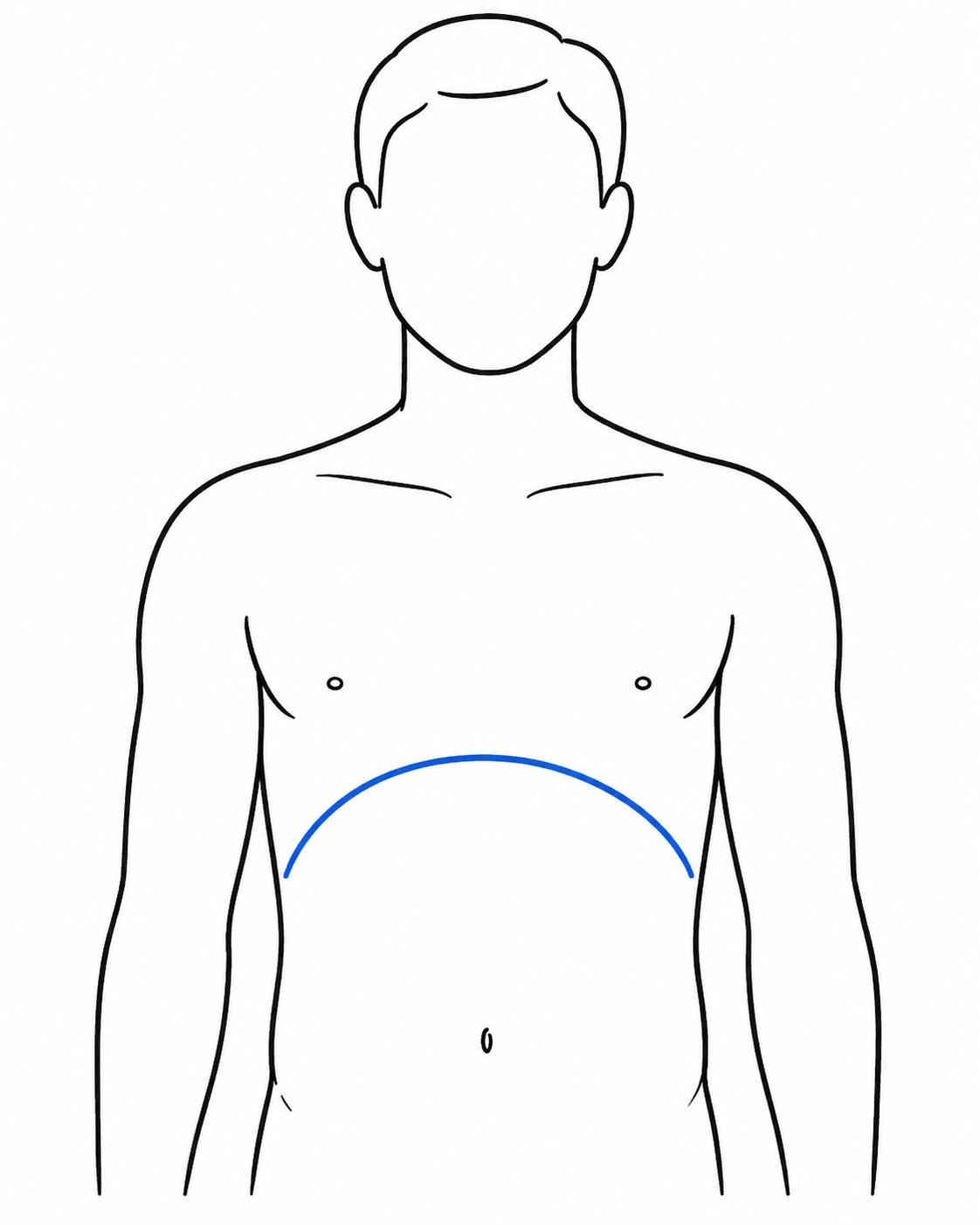
In simple words, the diaphragm is a muscle. It is quite wide and flat, and it separates your chest from your abdomen. It is also very thin when relaxed, roughly a couple of millimetres. Your ribcage is above it. Most of your organs are below it.
It looks a bit like an umbrella.
The wrong way to use your belly
Stand up for a moment and direct your attention to your abdomen.
Now try to expand your belly as if someone asked you to pretend you were pregnant.
Notice the muscles you use to perform this movement.
And before you get too excited about this skilful mind-muscle connection, please log it in your mind as WRONG.
This kind of forced belly pushing is a very common misunderstanding in “belly breathing” exercises. Tensing your abs and pushing your belly out is not what we’re looking for here. During a normal inhale, your abs are not directly involved. Most of the work is done by the diaphragm, with help from the muscles between your ribs. So, please don’t force your belly forward.
Don’t be too upset about abandoning your abs though. They have their role. Abs are more involved when exhaling, especially forceful exhaling.
Try this:
Exhale all the way out.
Then, instead of inhaling straight away, exhale a tiny bit more.
And then a tiny bit more.
And then a tiny bit more.
You will probably feel your abs contract.
This contraction happens automatically, particularly when the exhale becomes more forceful. You didn’t purposefully involve your abs, your body did it instinctively when required. So in normal relaxed breathing, there is no need push - just trust your body to do its thing.
How does the diaphragm work?
The first thing to understand is that air entering your body doesn’t expand your diaphragm. It is the other way round. The movement of the diaphragm changes the pressure inside your chest, which helps draw air into your lungs.
Imagine using a plunger. Your pipe is blocked. Something is stuck inside it. As you pull and press the plunger, the pressure changes inside the pipe and helps move what is stuck. That is what the diaphragm does with pressure in your lungs.
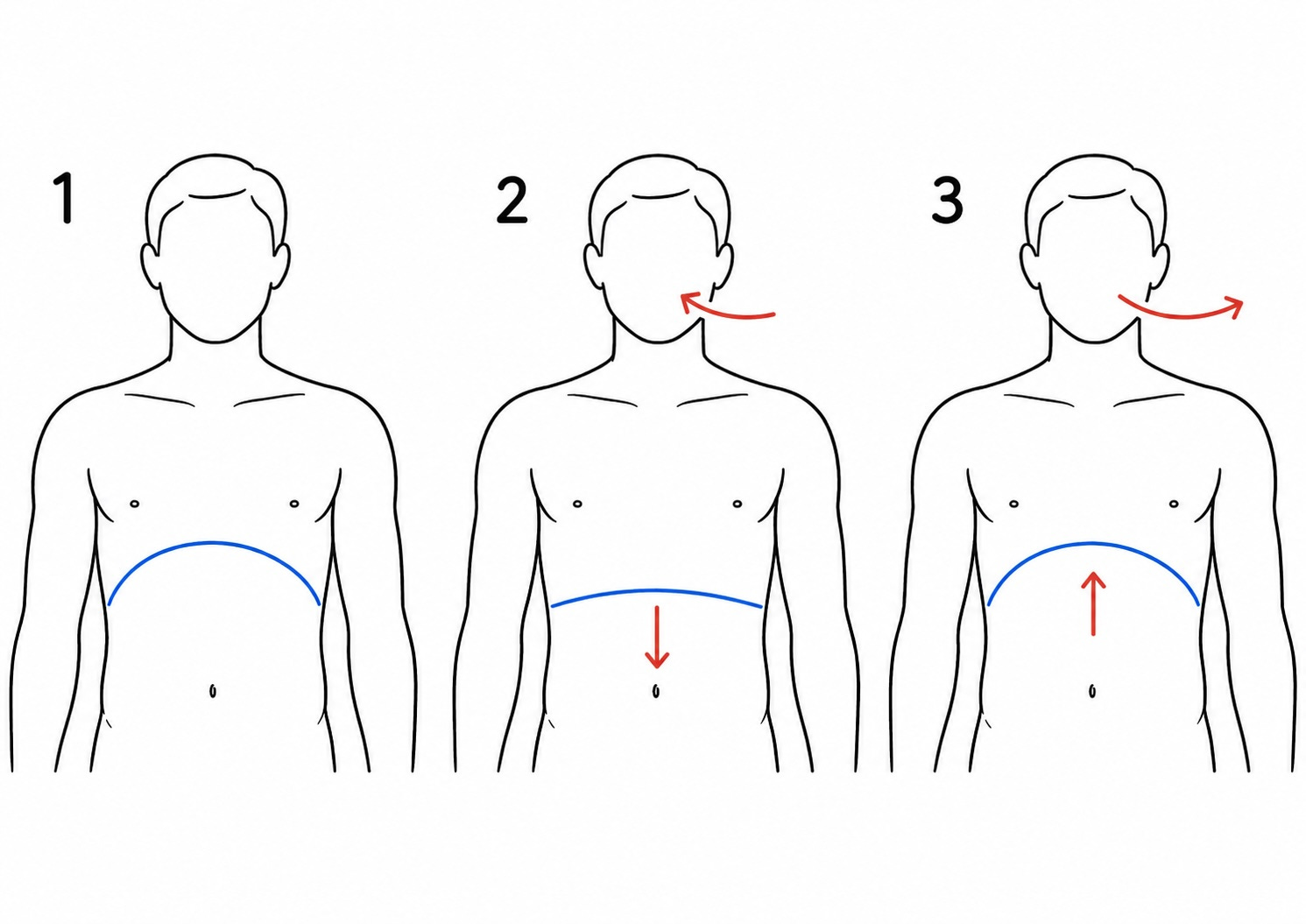
When the diaphragm moves from its relaxed curved shape and starts flattening downwards, it’s trying to create more space in the ribcage. This change in space and pressure helps air enter your lungs. Check out the below visual demonstration of how the diaphragm moves.
Mouth vs Nose
You’ve probably heard that mouth breathing is bad for you.
That’s generally true. Sometimes mouth breathing can be useful, especially when your nose is congested or you need more air quickly.
But for calm breathing at rest, use your nose if you can.
Inhale through your nose. Exhale through your nose.
This is what your nose is for.
I can tell you more about nasal breathing another time.
Movement in the chest and shoulders
It is very common that when someone takes a deep breath, their whole upper chest and shoulders move upwards. This is not ideal if you’re trying to calm your system down. That’s how we commonly breathe when we’re stressed, breathless, or just trying too hard.
Your chest is definitely involved. Just not this way.
Your ribcage is designed to expand when you breathe. All the way round. Whereas lifting and tensing the shoulders means the lower ribs barely move.
When your diaphragm moves down and air starts entering your lungs, your belly may naturally expand slightly, but the rest of the movement happens in your ribcage.
Your ribs should open up in all directions.
Towards your back.
Towards your sides.
And towards the front.
The natural pause between breaths
Imagine you are lifting a heavy item above your head and then putting it down on the floor multiple times. It is much easier to rest when the item is on the floor. Taking a break while holding it above your head would require a lot of tension. It wouldn’t feel exactly very relaxing.
Breathing is similar. As we’ve established, the diaphragm has a dome-like shape when relaxed. Then it contracts and moves down to help draw air in. This means that holding the breath after an inhale requires more effort because the muscles have to stay contracted.
During the exhale, the diaphragm returns towards its natural curved shape. At the end of a relaxed exhale, there can be a natural pause. No forcing or tensing. Just a nice peaceful moment before the next inhale arrives.
How to breathe with your diaphragm
So let’s look at a natural breath, step by step.
Make sure you are not tensing.
Keep your belly, chest, shoulders, and neck relaxed.
Close your mouth.
Rest your tongue at the roof of your mouth.
Gently exhale. Do not force it.
Now your lungs are ready for another breath.
Direct your attention to where the diaphragm is. Do you remember its shape?
Now allow some air to slowly start enter through your nose as you imagine a gentle movement downwards in your diaphragm. Not forward. Downwards.
As you continue with the inhale, air slowly enters your lungs.
Your ribcage slowly expands in every direction.
Try for this to be a natural as possible. No tensing.
Then you let go.
Air starts leaving your lungs.
Again, no tensing required. Just letting go.
At the bottom of the movement, you may notice some natural tension from your abs contracting. This is okay, as long as you are not forcing it.
Then a natural pause happens.
Enjoy it.
The pause is my favourite bit when doing breathwork. Nice and peaceful. I can tell you about experimenting with longer breath retentions another time.
Useful tip: The above steps of course require quite a lot of effort and attention from you. They will become more instinctive over time. Start with intentional breathing practice, so that at some point your natural breathing adapts. This includes breathing at night becoming calmer and more efficient.
If you try this and still feel confused. It’s okay. It takes some time. But at least now you won’t be mistaken for a belly dancer.
Thank you for reaching the end of this article.
I’m glad you’re here :)


Belly breathing is great! I love how you explained it. I hope more people give this a try.