


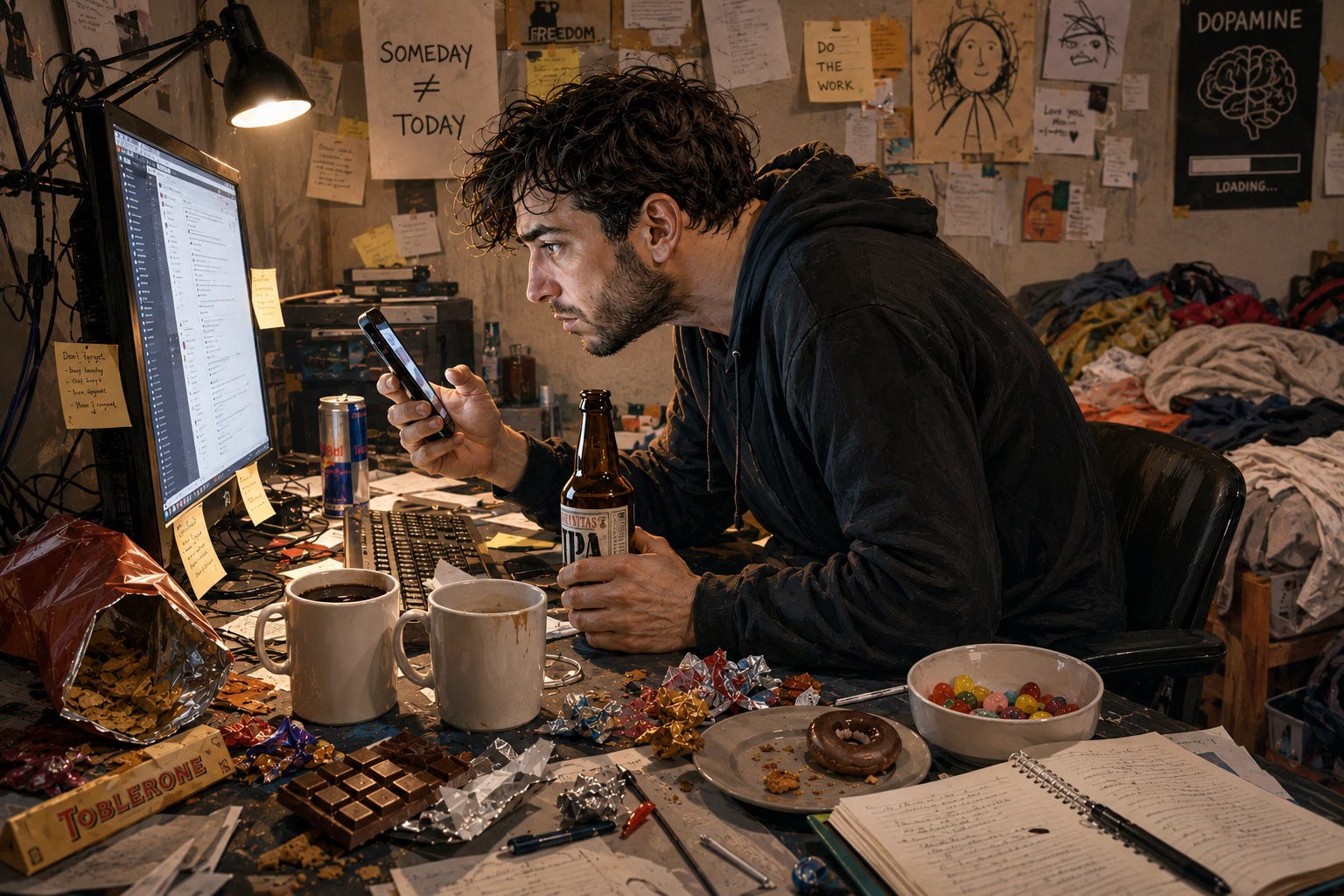
First, destroy sleep
If I wanted to ruin my mental health, I would start by taking away something fundamental for human wellbeing.
Sleep.
Good quality sleep is the foundation for psychological functioning. Perfect place to start.
I would consume a lot of caffeine in the afternoon and follow it with the biggest meal of the day in the evening. The aim is to make my sleep lighter, more fragmented, and less restorative. Before going to bed, I’d watch a film, ideally something triggering, so that my nervous system gets activated. Bright light from the big screen, an alcoholic drink, and ultra-processed snacks could go with it as an added bonus.
I’d make sure I’m not using curtains. Blackout curtains must be avoided at all costs. They block light, but any light from the outside can make sleep lighter or wake me earlier than I need. Perfect.
I would ensure all windows and the bedroom door are closed. This helps reduce air circulation. Less fresh air, worse air quality, and a warmer room than is needed for good sleep. Exactly what we want.
I would roll into my bed and scroll on my phone, ideally aiming to process as much information as possible. I’d choose an app that gives me a new little piece of information or reward every few seconds. This helps to ensure I feel overwhelmed, brain fogged, and depleted.
It’s time to go to sleep. Let’s leave my phone on the side, fully turned on, so any notifications wake me up throughout the night. Possibly put the TV on in the background, so there’s constant noise interfering with my sleep too.
As I’m drifting off, I would worry about the consequences of my bad sleep. I would analyse how many hours I’ve got left and think about how bad I will feel tomorrow.
Start the day scattered
I should wake up nicely sleep deprived, making it a good start for a dysregulated day.
The morning plan is easy. I must make sure I avoid any possible healthy activity. No exercise, no healthy breakfast, no hydration. Ideally, start by reaching for my phone and scrolling in bed. This helps to make sure I feel scattered before the day has even started.
Dysregulation in other areas is also important. After a longer scrolling session, I’d drag myself to the kitchen to make a coffee. Ideally with sugar and on an empty stomach. Sugar will help dysregulate my energy, especially if I follow it with a carb-heavy or sugar-heavy breakfast. I’d go for something like cereal, flapjack, pastry, jam on toast, or a fruit juice. Let’s make sure I get the biggest sugar spike possible, so that I can crash later.
Avoid sunlight, movement, and food
Now the day has started, I must make sure I don’t go outside. Morning sunlight has too many benefits.
Ideally, stay in one static position, preferably one straining your neck. Hunched back and head-forward posture is perfect for this. Let’s sit this way for a good few hours. Absolutely no exercise, no movement, no stretching, no breathwork, no hydration - they are too good for us.
Procrastinate and multitask. Be reactive
Let’s start staring at my to-do list. This helps feel more anxious and overwhelmed. At this point, it’s good to remind myself how important these tasks are and then totally ignore them. Any form of procrastination would work well here.
To make sure I don’t prioritise long-term goals, I would start by opening my emails. I wouldn’t action any, just flag them for later. So that I know I have a lot to do, but I am failing.
Before getting anything done, let’s make sure the to-do list is visible, the email app is open, the phone is visible on my desk, and all notifications on both devices are switched on. Feeling scattered is the aim. Any noise or notification should grab my attention. We’re aiming for a loss of control.
Let’s start multitasking.
Start working on something very important but get distracted at every opportunity. Be reactive. Check every notification and engage in useless tasks. Reorganising phone home screen icons or checking recent bank transactions are great examples.
Lose sight of your goals and priorities
I would respond to some emails that are not important. Ones that prioritise other people’s needs. If my colleague asks me about something they could easily find on Google, I would make sure I write a great detailed response, better than Google. This way, I waste a lot of time and start feeling like other people’s needs are more important than mine.
This would be a good moment to start targeting self-esteem. When we’re failing at something, it is the best time to ruminate, criticise ourselves, and dwell on how bad our life is. I’d do this until I max out on feeling down and anxious.
I nearly forgot about another important factor.
Emotional suppression.
It plays a role in many mental health difficulties.
Avoid emotions
Let’s avoid emotions as much as possible.
Once I feel anything unpleasant, I would just push it to the back of my head. Every time I feel a little sad, embarrassed, or guilty, I should simply find the first thing in front of me that would block it. Plenty of options here, but I would probably choose between mindless scrolling of funny videos, playing a game, or snacking on sugary food.
The aim is a short-term relief and total ignorance of long-term goals.
Isolate Yourself. Push people away
It is crucial I also avoid any possible real-life interactions with people. No phone calls, no video calls, and definitely not leaving the house.
If, for any reason, I am forced to talk to someone, I would make sure I am masking. It would be important that I put a front on, pretending I am having a great day. This way, I would limit any social support available.
When a difficult topic is raised, I would simply agree with them. Expressing my opinion and standing up for my values would be too good for me. It’s better to feel demoralised.
When talking to other people, I would avoid asking them any questions, to make sure the conversation is one-sided. Sticking to small talk and avoiding curious or engaging topics would mean my social image gets a bit worse over time. Ideally, I should push people away, so gradually my social support network gets smaller. The goal is total social isolation.
It would be important to also take my family for granted. They are family, so there’s no point checking on them, spending time with them, or showing interest in their life. To make it slightly worse, I could also blame them for it, why not? This will definitely create some conflict, including internal conflict.
Ignore body signals. Stack short-term rewards
My back or neck will start hurting from being in one position. I would ignore these signals.
By this point, I should be feeling agitated, sore, down, and depleted. A decent crash in energy is starting. This is the point where I should avoid any healthy food so my body doesn’t get any fuel. Just wait for the sugar cravings and then destroy a bar of chocolate or a tube of ice cream in one go.
Having some tasty food offers a nice spike in pleasure. This is the perfect moment to stack as many short-term rewards as possible: snacks, alcohol, energy drinks, games, fantasy football, gambling, dating apps, online shopping, checking investments, browsing memes. Options are endless.
Use social media excessively
I’d make sure I upload a story or picture to all social media sites, ideally one that shows a completely different lifestyle than the one I currently have. Make people jealous and aim for a lot of likes and comments. I want people praising me for the amazing things I do, when in reality I am feeling crap. This will definitely make me feel slightly fraudulent and ashamed of myself.
Make sure you use multiple social media sites at once. Then engage in compulsive checking of them in a never ending circle.
We’ve reached a big crash. Mood is very low, no motivation, no energy, anxiety through the roof, negative thoughts taking over.
Take zero ownership. Blame the world
This would be a good moment to start blaming other people. I would make sure I don’t take any ownership of anything. Complain to my manager about the work systems, message my friends complaining how busy I am, and ruminate on how much easier life was for the previous generation.
Blaming external factors and feeling sorry for myself will provide a temporary distraction and guarantee that nothing at all changes in your life. Now you can blame the environment and the system around you whilst staying emotionally unwell. Being stuck in a chronic conflict with yourself is at the core of mental health problems.
Apply the “screw it” mindset
By now, it feels like the day is ruined. It would be great to use this as an excuse and say something like, “Screw it, it’s ruined anyway, I will start good habits from tomorrow.”
This helps to make sure you never start good habits. You can simply say the same thing tomorrow. But for the rest of the day today, you have a good excuse to engage in as many unhealthy activities as you can. Making the false promise that this is the last time allows you to max out on unhealthy activities causing mental health destruction.
Once the day is officially complete, it would be important that you check your work emails after hours, simply to keep track of your accumulating work. It also helps to track any consequences of today’s failures, keeping a consistent stream of anxiety spikes.
Try to fix everything at once, push your limits
Once I reach rock bottom, I would watch YouTube videos about mental health. The best ones would be things like “How to fix depression in 1 minute”. Ideally, I’d watch at least 50 of them, so by the end I don’t remember anything and have no idea what to do.
Once I bump into a video of a motivational speech, I’d totally go with my gut instinct. I feel something positive, so I might as well follow it.
It’s time to sort my life out. Let’s go to the gym!
I am hungry, but there is no time to waste. This will be the perfect time to go. My body is under-fuelled, my energy is low, and my nervous system is absolutely depleted. It’s time to do a workout and totally ignore any body signals. Ideally, aim for heavy weights or a high-intensity session, or even better - try to tackle my personal records. Don’t do any warm-up.
Between the sets, I’d make sure to scroll on my phone. Wear headphones to avoid any social interaction, but quietly stare at other people’s physique. Comparing myself to those who look better than me is perfect here. Ignore those who look worse and never compare yourself to people who never came to the gym; only focus on those who look like machines.
If I notice any signals such as pain, discomfort, or my hands shaking, I’d just push through it. We’re aiming for total depletion. Once I can barely walk, the job is done.
Skip the shower. It helps to avoid any uncomfortable social situations in the changing room. We want to shrink comfort zone. Skipping the shower also means I stay uncomfortable in my body for longer. Perfect.
As I’m leaving the gym, a person smiles at me. This is risky! I felt something positive. The best option here is to lower my gaze, pretend I haven’t noticed, and leave the gym as soon as possible. Ideally, tell myself they were probably laughing at me.
Overindulge on unhealthy food
On my way home, I’d just follow my instincts. I’m starving. Stop by a kebab shop or another fast-food option. I’m hungry and my body is shouting at me to get some fuel. This time, I will listen.
Let’s order a double or triple portion and consume it as fast as possible. It would be good to scroll on my phone at the same time, maybe checking my work emails again. No time for mindful eating. Make sure it’s as ultra-processed as possible, use a lot of sauce, and consume it with a bottle of ‘full-fat’ coke. Don’t forget to buy a dessert, maybe a large milkshake, and then down it in one go.
Get the '“wrong” help
Once I reach home, I should feel absolutely destroyed.
Bloated, sore, down, anxious, confused.
These feelings are unbearable, so let’s try to get some help. I would start a conversation with ChatGPT. The best option here is to give it absolutely no context. Just say something like, “I feel crap. What to do?”
This way, you’ll get the most generic advice possible. Then be very selective when reading these ideas. You want to ignore anything you don’t like and only focus on the things you prefer. If, for any reason, you don’t like any of its suggestions, just say it, until ChatGPT pleases you and tells you exactly what you want to hear. It might take 3-4 prompts, but you’ll get there.
This helps to finish the whole routine by confirming your own beliefs and staying stuck.
Now it’s time for some more alcohol, caffeine, scrolling, avoidance, games, and…
Okay.
Enough.
Pause. Reflect.
Let’s pause here.
I am feeling too creative and starting to feel guilty! I was hoping for this article to be short, but I have too many ideas coming to my mind.
Being unhealthy is so easy. So many options!
This article is a little provocative. My apologies if at times I’ve pushed the paradox too far. Of course, mental health is not only about lifestyle and habits. Biology, stress, trauma, relationships, illness, money, work, support, and many other factors matter too. But our daily patterns still count. They accumulate.
I find that sometimes flipping a topic on its head really helps to gain a new perspective.
Identifying what behaviours direct you to the opposite goal means identifying what takes you away from your goal.
I think it can be refreshing. It helps to wake up.
If you’re aiming to have better mental health, but you’re regularly engaging in activities from the above recipe for a mental health disaster, then you’ve got something to reflect on. I do too. We all do.
Many things affect your mental health.
Each one does it separately, but they all accumulate. Most of these behaviours look small in isolation. That is exactly why they are easy to ignore
Changing everything in one go is probably not a good idea. But...
Why not select your top three priorities, and make them your focus for the next week?
I’ve combined all of the discussed factors below into one long list.
Read through it.
Pick three.
Try modifying them for a week.
Notice what changes.
Let me know how it goes
• Afternoon caffeine
• Heavy meals late in the evening
• Watching activating content before bed
• Using screens late at night
• Sleeping in a bright room
• Sleeping in a warm, stuffy room
• Scrolling in bed
• Leaving notifications on overnight
• Leaving the TV on in the background
• Worrying yourself to sleep
• Counting your sleep hours
• Starting the day with phone in your hand
• No morning sunlight
• Poor hydration
• Sugary breakfast
• Alcohol
• Relying on caffeine and sugar for energy
• Sitting still for hours
• Avoiding exercise or movement
• Poor posture
• Ignoring body signals
• Avoiding going outside
• Staring at a to-do list without acting
• Starting work from opening emails
• Tidying or flagging tasks instead of doing them
• Keeping notifications switched on
• Keeping your phone visible while working
• Multitasking
• Reacting to every notification
• Procrastinating with small pointless tasks
• Prioritising other people’s needs over your own
• Ruminating, self-criticism, catastrophising
• Suppressing emotions
• Doom scrolling
• Comfort eating
• Avoiding phone calls
• Avoiding real-life interactions
• Pretending to be okay, masking how you feel
• Avoiding vulnerability
• Agreeing with people. Not standing up for your values
• Keeping conversations superficial
• Not asking people questions
• Pushing people away
• Neglecting family and close relationships
• Not taking responsibility or ownership
• Eating quickly and mindlessly
• Scrolling while eating
• Checking work emails after hours
• Choosing quick pleasure over long-term goals
• Stacking short-term rewards
• Compulsive checking or online activity
• Playing games to avoid reality
• Posting online for validation
• Chasing likes and comments
• Presenting a false version of your life online
• Consuming endless self-help content
• Searching for quick fixes
• Taking impulsive actions to get better
• Asking ChatGPT vague questions and expecting useful answers
• Being selective with your reading. Ignoring advice, you don’t like
• Seeking reassurance instead of change
• Exercising when depleted
• Skipping warm-up before a workout
• Ignoring pain or exhaustion
• Comparing your body to others
• Avoiding small positive social moments or opportunities
• Taking the “all or nothing approach”. Saying “the day is ruined, I’ll start tomorrow”
• Trying to change everything at once
• Repeating yesterday’s mistakes today, and today’s mistakes tomorrow.
You can’t knock any of this when you take it on face value and you do admit that there are others factors involved - but it very much works on a basal assumption that humans make decisions based on logic which the majority don’t – and it also doesn’t take into account the fact that the diagnosed conditions are at play – if you’re depressed you don’t care enough to even brush your teeth or wash – that’s where you’re at – the sugary snack may provide a small moment of happiness/pleasure in a dark place – when anxious you don’t want to be around people – the gym is one of the last places you wanna be right now – and isolation is safety - it’s less overwhelming… this list could go on and on.
In no way at all am I saying this is wrong because it’s 100% right – but only if you look at it from one perspective .
You can know something isn’t helping long term but it’s what you need or want or feel in the moment. And yes that’s an issue. But it’s also the issue.
If You aren’t thinking rationally or logically and you don’t really care about anything.
But generally speaking it was a very good read and the point is very important and clear.
This really makes you stop and think about how many small habits quietly add up over time. Great read.