



There is something very special about coffee.
And probably only coffee drinkers can relate.
Everyone has their own reasons for consuming it. Some rely on it to manage sleep deprivation, some simply enjoy the ritual, others seek additional mental stimulation.
I am probably in the latter group. I’ve always found caffeine helps me with concentration. I also enjoy the ritual and believe there is much more to it than popping a magic caffeine pill.
As I am writing these words, I am sat in a cosy café near Leeds docks, sipping my flat white with perfect milk foam art on top. It’s become my weekly journalling and reflection time. The presence of coffee just makes it more special.
It has crossed my mind, that this coffee might not be guilt-free. It’s my second coffee of the day. What are the chances the quality of my sleep will be affected?
It’s only 12 o’clock. You might think it’s a little dramatic to worry about it. And you’re probably right. To be honest, I’m not worried, but simply can’t stop myself from seeing the difference between these thoughts and what science supposedly tells us.
Let’s make sense of this problem from both a scientific and anecdotal point of view.
Hopefully, by the end of this article, you (and I), will have a clearer answer to this dilemma.
What does caffeine actually do?
Once you consume your cup of coffee, it takes about 10-20 minutes to start feeling the first effects. You’ll reach a peak at 30-60 minutes with a boost in energy, mental clarity, and motivation.
Caffeine blocks adenosine, the brain chemical responsible for making you feel sleepy. It also affects things like dopamine and adrenaline. This naturally leads to alertness and focus, but also some side effects like jitteriness and anxiety depending on the dose and context.
How long does the stimulation last?
But where does this additional physical or mental energy come from? What resources are being used? I haven’t consumed any additional calories or provided my body with fuel it can burn.
The truth is that caffeine doesn’t create energy. It just hides tiredness. In other words, we could say you’re borrowing energy from the future. You’re enjoying a couple hours boost at the cost of a crash later in the day.
Your brain doesn’t stop producing adenosine. Caffeine is blocking it, but adenosine is quietly building up in the background. Once caffeine starts to wear off, all the accumulated adenosine starts binding again. That’s the crash.
So in simple words, coffee blocks your tiredness signal. It builds up. Then it all comes through at once.
Enjoying this article? I write about mental and physical health, and I’ll likely write about coffee again. All articles are free - whether you read them here or subscribe to receive future posts straight to your inbox.
Does the energy crash mean better sleep?
If caffeine borrows energy from the future, then in theory you will be more tired in the evening. It sounds like a perfect scenario. You enjoy the benefits of caffeine to improve your productivity and then drift off into a better sleep later that day.
I wish that was true. Unfortunately, it’s kind of the opposite. Caffeine activates your nervous system. What people experience as feeling “wired” is a result of sympathetic nervous system activation - the same response that’s triggered when you’re in danger. Adrenaline raises, blood pressure goes up, and your heart beats faster. It’s, of course, a much milder version of it.
If you’ve ever gone too far with those lovely espressos, you know exactly what I’m talking about.
This nervous system activation stays as long as caffeine is in your system. And unfortunately, caffeine stays in the body for much longer than we think.
The coffee I consumed today will still be in my system tomorrow.
Really?
Well, yes.
On average, it takes 5–7 hours for your body to metabolise half of the caffeine consumed. Then another 5–7 hours to process half of the remaining half, and so on.
My flat white containing approximately 150 mg of caffeine will be combined with the remaining caffeine from my morning coffee. It’s probably easier to show this visually. Let’s assume a caffeine half-life of 6 hours, meaning it takes 6 hours to remove half of the caffeine consumed.
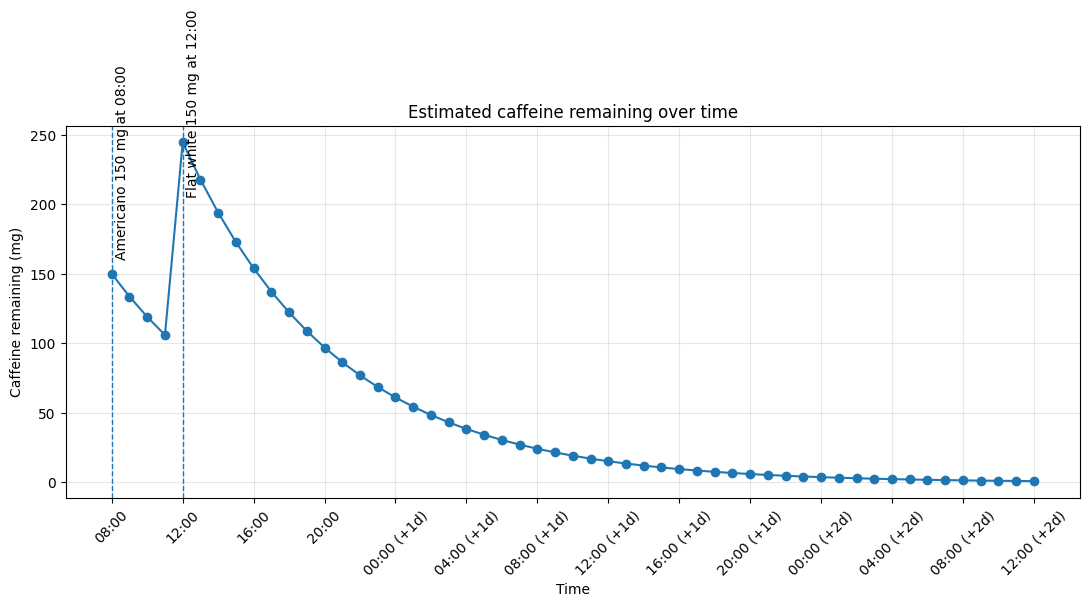
Approximately 15 mg of caffeine will still be present in my body tomorrow at midday, assuming I skip my morning coffee (which I probably won’t). Apparently, it will take over 2 days to reach levels close to zero.
What does this mean for my sleep?
If you’ve had a busy day, you will probably fall asleep regardless. I am also likely going to fall asleep tonight. I have an eventful afternoon planned, providing therapy to a couple more client followed by a long padel match in the late afternoon.
However, if we trust science, we would need to assume that the quality of my sleep will be affected. Sleep is such a complex process, involving different phases and mechanisms of recovery.
We often assume that falling asleep and staying asleep means good sleep. But… Good sleep means restful sleep. Caffeine results in much lighter sleep. It tends to reduce total time spent in deep sleep. It can also negatively impact REM sleep, reduce blood flow to certain parts of the brain, lead to physiological changes such as increases in cortisol, increase the tendency towards worry or negative images, increase urine production, and raise body temperature. Combining these factor with many others I haven’t listed means sleep that is much less restful.
It takes longer to fall asleep, it is harder to stay asleep, and you are less likely to wake up in the morning feeling restored. Meaning you will need more coffee tomorrow.
Should we trust science on this?
It’s very possible you’re reading this and thinking this is all a little excessive. And I totally agree. Science is one story, but your experience is another.
My coffee cup is empty, and unless I order another one, I will need to release my seat for another caffeine enthusiast. But let’s conclude this reflection from a completely different perspective.
What if you could enjoy your coffee and simply accept the full picture of pros and cons?
Every single day we make choices. Some are bad. Some are good. But most are debatable. They depend on the context.
One of my favourite ways of thinking about choices is by contrasting them with my personal goals. If this cup of coffee was truly getting in the way of my life goals, it would be important to rethink it. Decaf coffee also exists.
But what if the goals caffeine helps me achieve are more important than the ones it gets in the way of?
If we take a simple assumption that the quality of my sleep will be 10–20% lower, is that okay for my overall wellbeing this week?
Is there a chance the wellbeing boost I get from today’s caffeine-related activities is greater?
I’ve benefited from helpful reflection space and writing, enjoyable mental stimulation, a sense of productivity, fulfilled curiosity, and even social goals, as I know these reflections will be shared with others. There are even more important things - consistency with my own vision of who I am, what I do, and the role I want to play. And even my deeper thoughts about the more philosophical question of how much life is about the balance between enjoying it and optimising health. There is a lot to it.
I’ve had my first coffee over 15 years ago. I’ve learned to understand how it affects my body and how far I can go with it. There have been times I definitely used too much of it, but also times I took a few months off caffeine with various positive effects.
Whatever perception I had of this flat white today was fully consistent with my vision of the day, the week, and my life in general. It is completely guilt-free. Ordering one more coffee would probably mean a different story and more significant internal conflict. It’s also very possible I will feel differently next week, when my priorities, health, and context are different.
Maybe instead of assuming coffee is bad for sleep, we should check in with our goals and decide whether it’s worth it today.
I’m still fairly new to writing here. Comments, reflections, disagreements, or personal experiences are very welcome.
Do you notice afternoon coffee affecting your sleep? Or are you one of those people who can drink a double espresso before bed with no issues? Feel free to leave a comment.