


A couple of years ago my neighbour was turning 80. I knocked on his door, ready to say happy birthday over the doorstep.
Before I could blink, I was already sat on his sofa with a glass of red wine in my hand, my girlfriend by my side, and my neighbour and his wife smiling from the sofa opposite.
The room had that old-school, slightly simplistic décor that somehow made the whole thing feel even better. Usually when he offers me wine, I say no. I’m often on my way to work, about to drive, or planning a gym session. But this time was different. I was ready to enjoy myself.
He lifted the bottle, smiled, and said, “I have been drinking wine for over 60 years, and this one is my favourite.”
I looked at his wife. She smiled too and said, “He loves his jammy red.”
Watching the two of them in their 80s, full of energy and warmth, I did have the thought: maybe wine really has done something for them.
That is exactly why headlines about wine being healthy are so attractive. Many people love it. And those who do often live quite good lives.
The new study from Italy sounds promising at first. Large sample size. Over 22,000 participants. Thirty-six blood biomarkers. Multiple authors. A detailed analysis.
And then the exciting bit, the conclusions: men drinking a moderate amount of wine appeared “biologically younger” than abstainers. If you take their model literally, the magic number was around 172 mL of wine per day, which is approximately a standard medium glass of wine. That meant the difference of 0.34 to 0.39 years, depending on the analysis. In other words, about 4 to 5 months younger on paper, or, if we’re being a bit silly with the maths, around 0.7% younger.
If you enjoy wine, it sounds like a double win. You can drink it every day and call it healthy. You can easily imagine people treating that as a little longevity hack. One avocado a day, one apple a day, and one glass of wine to keep yourself 0.7% younger on paper.
Not so fast.
Before you start treating your wine rack like a health intervention, let’s take a step back.
Before trusting the headline, it’s worth asking a few boring but important questions. Does the study really support the conclusion people are taking from it? How much can it actually tell us? Are there any obvious reasons to be cautious about the conclusion?
One obvious question is whether there is any conflict of interest. On that point, the answer seems reassuring enough: the paper doesn’t declare wine-industry funding, and the corrected funding statement points to the Italian Ministry of Health, with no conflicts of interest declared by the authors.
So the real issue here is unlikely to be some dramatic conspiracy. It is something more ordinary.
Correlation Can Make Us Do Very Silly Things
Correlation does not equal causation. If you have ever read anything about statistics, you’ve probably heard that sentence before. It’s repeated so often that it can start to sound boring.
So let’s make it less boring.
Would you make life changes if you saw any of the below headlines?
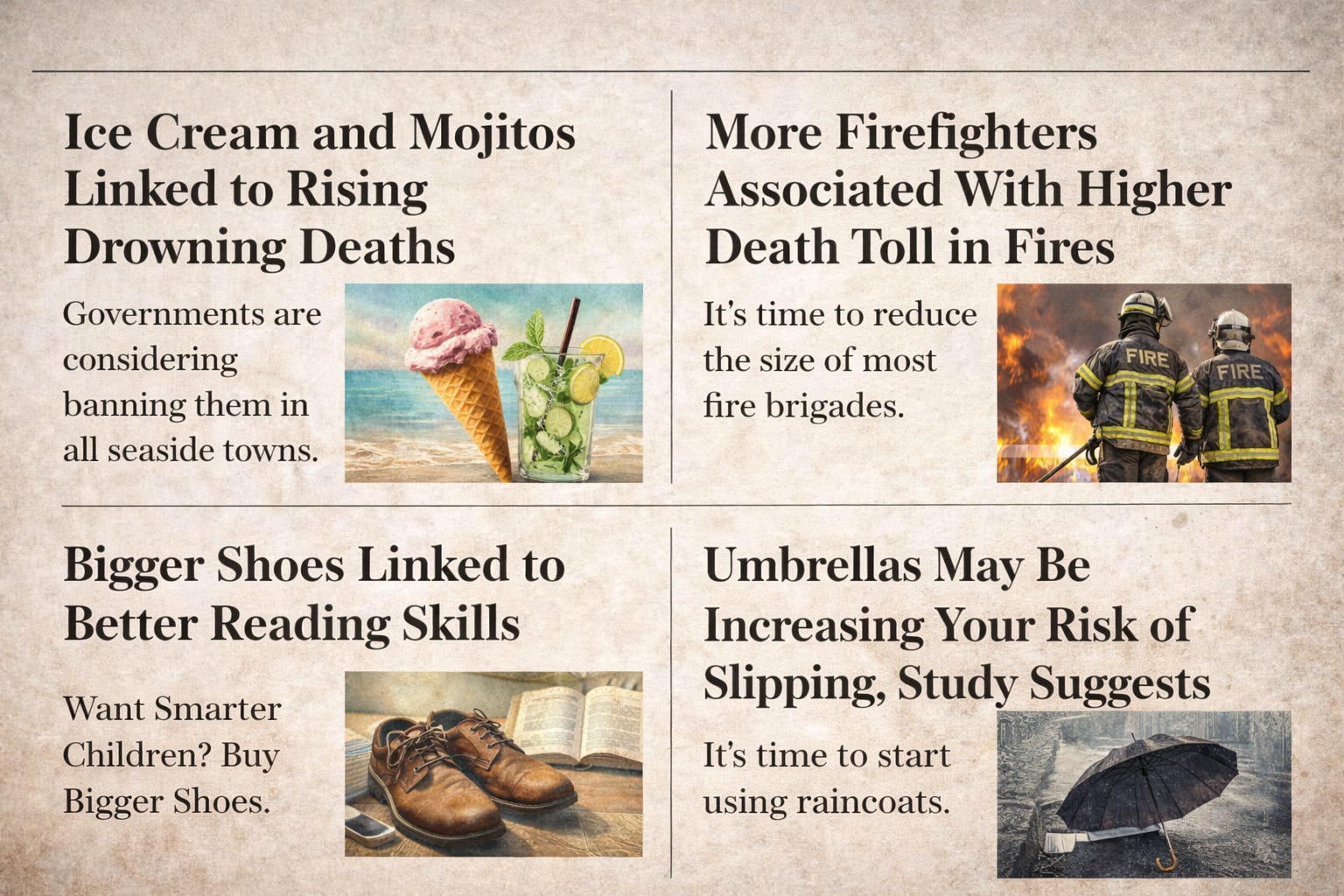
If correlation meant causation, we’d have to make very silly changes. Ban cold drinks, blame firefighters for fire deaths, totally prohibit umbrellas, and intentionally wear bigger shoes.
The reason these correlations don’t work is that the relationship between two things can often be explained in another way. Children who are learning to read have smaller feet, so naturally those with bigger shoe sizes, i.e. adults, tend to read better. Cold drinks and drowning deaths are both driven by hot weather. Umbrellas and slipping accidents are both driven by rain. Firefighters don’t kill people - they try to save them. The more people need saving, the more firefighters arrive to help.
The same shift in perspective can be applied to the wine study.
The finding was linked to wine specifically, not alcohol intake overall. That makes it look as though there is something uniquely beneficial about wine. But can you think of reasons why someone who drinks small amounts of wine might appear healthier in a study than someone who doesn’t drink?
Why moderate wine drinkers may look healthier
So what might characterise people who drink only one glass of wine?
They sound a bit like people who say things like “just a small glass with dinner” and actually mean it. They can probably also leave half a packet of biscuits in the cupboard and forget about it. That alone makes them a suspiciously unusual group. More seriously, they may differ from other groups in all sorts of ways that the study cannot fully capture.
It may simply be that people who drink small amounts of wine differ in other important ways as well. They may be more likely to drink with meals, drink slowly, socialise differently, value rituals, or live lives that are healthier in all sorts of small ways.
And then there is the comparison group: the abstainers.
Why are they abstaining?
Again, I’m speculating here. Some may avoid alcohol because they are already unwell, because of medication, because of mental health problems, or because of religion, culture, or personal preference. Others may have reasons a study cannot easily capture.
The point is that “non-drinkers” are not necessarily a clean, healthy baseline.
For a correlational study to allow for a strong conclusion, we’d need to eliminate, or in study terms, control for, all the other important factors that might explain the difference. The study did try. It considered around 20 factors, including age, sex, diet, education, BMI, physical activity, smoking, and some health conditions. That is not nothing.
But it’s still not enough.
Because there are many things they did not, and realistically could not, fully control for: wealth, access to healthcare, reasons for abstinence, drinking history, sleep, stress, mental health, social functioning, medication, occupation, and the wider context in which people drink.
The study simply couldn’t adjust for the full context of people’s lives.
What if the “winning” group in the study - the group that may already differ in resources, habits, or social context - had chosen not to drink wine at all? Would they suddenly become less healthy purely because the wine disappeared? Or might they still have looked relatively healthy anyway?
At this point you may be fed up with my scepticism. Fair enough. Before I change the tone and try to be more optimistic, let me give you one more reason why this headline still isn’t very convincing.
The resveratrol explanation falls apart quickly
The authors suggest that wine drinkers are healthier because of compounds such as polyphenols. Wine isn’t just alcohol. It also contains plant compounds that people like to romanticise. Resveratrol is the compound getting most of the attention here.
A glass of red wine contains only a tiny amount of resveratrol - around 0.4 mg in 150 mL, although estimates vary. Human resveratrol studies have used doses in the tens or hundreds of milligrams per day, and even then the evidence is mixed. There is currently no conclusive clinical evidence for broad health benefits of resveratrol in humans. See this 2024 systematic review: LINK
So if red wine is healthy because of resveratrol, this is where the explanation becomes less convincing. A normal glass of wine simply does not deliver enough of it to make a meaningful health difference. What it does deliver, more meaningfully, is alcohol.
Quick maths suggests that to get into the kind of range used in human resveratrol trials, you would need somewhere between tens and hundreds of glasses of wine per day, depending on the estimate used. That is obviously not a plausible health strategy.
So where does that leave us?
Probably somewhere a bit less dramatic than the headlines.
After reading all of this, you might be less likely to believe that alcohol is good for you. That seems sensible. But does that mean you should never enjoy a glass of wine?
Not necessarily.
Wine, ritual, and why people still enjoy it
I’m not planning to make a health argument for alcohol. I don’t think alcohol is necessary for a good life. But I do think it is often tied to moments that are meaningful, social, warm, funny, and memorable.
That evening with my neighbour was a good example. We sat there drinking wine, laughing, and listening to his stories from the past. I remember quietly chuckling to myself as a few memories of him crossed my mind, especially the one of him showing me a set of air push-ups on his crutches a few weeks after knee surgery.
The wine tasted great. Knowing that more than 60 years of wine drinking had led him to call this bottle his favourite made it feel very special. I left that evening regretting that I had not looked properly at the label.
It took some time, but eventually I found the name of the wine. To my surprise, it was sold in most shops, inexpensive, and easy to get. I bought a few bottles and placed them on my wine rack for a special occasion, or maybe as a gift for someone who likes wine.
A few weeks later I opened one with dinner, expecting to recreate the magic.
It tasted good.
But it was missing the surroundings, company, and ritual.
That, I think, is the point.
A glass of wine can be enjoyable because it often comes with people, rituals, memories, meals, atmosphere, and the story attached to it.
The study’s headlines are a bit misleading, but if a glass of red wine here and there is your special thing, I don’t think you need to panic either. Life is not lived by stripping away every imperfect thing. Some things are enjoyable because they sit in that human space between health, risk, ritual, pleasure, and meaning.
If abstinence is your thing, or you are perfectly happy swapping wine for a cup of herbal tea, great. Keep going that way.
But if a glass of jammy red now and then is one of your small pleasures, that is fine too. It’s not all about optimisation. Life is also there to be enjoyed.
Just maybe do not pretend you are doing it for longevity.
Study discussed: Esposito, S. et al. (2026). Moderate wine consumption, defined by the Mediterranean Diet, is associated with delayed biological aging in men from the Moli-sani Study. International Journal of Public Health, 71. LINK
Thanks for stopping by. If you’d like to read more reflections like this, you’re very welcome to subscribe below.