


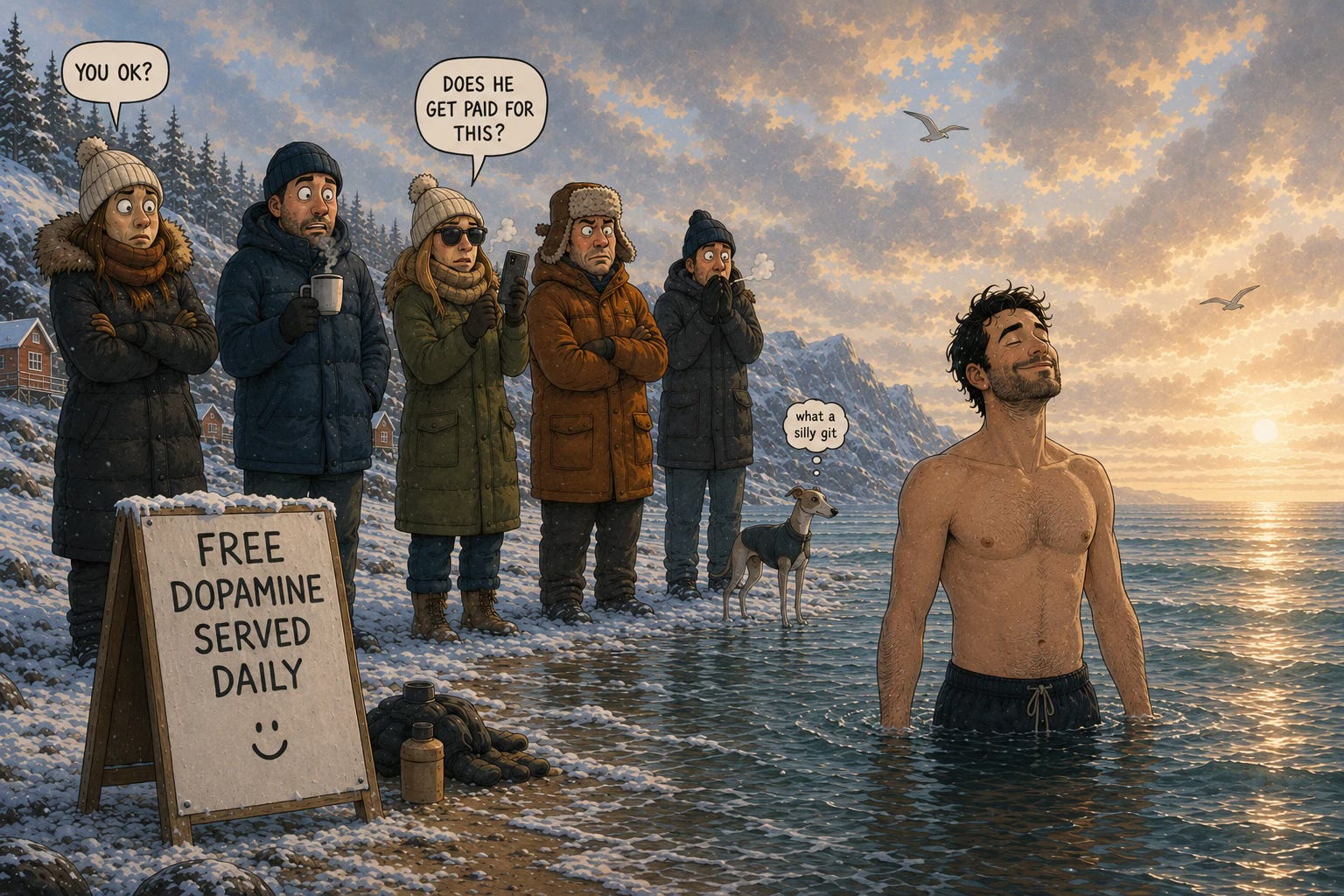
I was always impressed by people swimming in ice cold water. When I was a kid I first learned about it on the Polish news. My TV back then only had about five channels.
The news reporter was half-smiling when describing a story of an annual winter gathering of cold water enthusiasts.
The footage showed a group of people wearing speedos, warming up on a snow-covered beach. Then happily running towards the sea.
It’s minus 12 degrees [Celsius] today - commented one of them in the post-swim interview - perfect day for a swim.
In Poland they call them “morsy”, meaning walruses.
Walruses as animals are perfectly adapted to cold water as they thrive in the freezing waters of the Arctic. So the name makes total sense.
They showed similar footage every year. Back then, I just treated it as an interesting anecdote.
I would have never thought I’d become one of these crazy cold water enthusiasts 25 years later.
The first cold bath
It started in 2020. I was listening to a podcast about benefits of cold water exposure. Very quickly, I was sold. I was also going through some health problems at the time, looking for alternative health methods.
I turned the knob of my bathtub to the coldest setting. It was winter so tap water felt ice cold. I felt nervous and excited.
It was hard to get in, but I did it.
I fully immersed myself, maybe only my head and knees sticking out, and set a timer.
I noticed a wave of sensations going through my whole body. I couldn’t tell if it was pain, fear, or excitement; or a combination of all of them.
All I know is that staying in required a lot of willpower.
What happened next confused me.
After drying myself I started to feel very itchy. I learned later that this is caused by a rapid rush of blood back to the skin as it warms up.
Apart from needing a couple of hours to fully warm up again, I haven’t experienced any other negative effects. But.. I felt really good.
Within just a few minutes of leaving the bath I started to feel very calm. My mind was sharp. I felt focused and ready to tackle my to-do list.
It felt as if someone changed how my brain regulates dopamine. Now I know that’s more or less what happens. Cold water is one of the most powerful natural ways to increase circulating dopamine levels. And this increase lasts a few hours.
That’s also where I made my first mistake.
When it went wrong
I assumed more cold water meant more benefits. It didn’t.
After my first cold bath experience, I repeated it daily. Every morning. Gradually increasing the time spent in the bath.
After a few days I noticed an itchy but painful sensation in my feet. All my toes were red. It turns out I’d developed chilblains.
The answer was to take a 3 week break from cold water. Lesson learned.
Cold water can be an amazing tool. But… the dose is important. This taught me something important: less is often more.
More coffee doesn’t always mean better focus. More work doesn’t always mean more money. And more exercise doesn’t always mean more muscle.
The same way, more cold water doesn’t always mean more health benefits.
Over the last few years I experimented with different forms of cold water exposure, from home baths and wild water swimming in lakes and the sea, to specialist centres for contrast therapy where cold water and sauna are combined.
Some experiences were incredible. Some were questionable.
If you visited Whitby or Scarborough on a cold, autumnal day and saw a half-naked guy running into the sea - it was possibly me.
I’ve learned a lot in the process.
I do have some more nuanced reflections about cold water, which I will share in later articles. For example, does cold water spike cortisol and stress or does it reduce cortisol and stress?
But for now let’s focus on some basics. I’ve listed over 30 learned lessons, but realised nobody is going to read these. So I’ve condensed them into the 5 most important ones. Here are the top five lessons to get you started.
Safety first
Cold water is generally safe for healthy people, but it’s still important to use common sense. If you have underlying health conditions, especially heart problems, speak to a doctor first. Going too cold too quickly, staying in too long, or immersing your head can lead to a cold shock response, gasp reflex, hypothermia, and even drowning. But the steps below should help you approach your first cold bath safely.
What I learned
1. Breathe calmly
When you enter cold water your first instinct is to gasp for air. There’s nothing wrong with listening to your body and taking a breath when it’s needed. But in this case it’s not always a good idea.
I know you’ve seen Wim Hof’s hyperventilation videos and might want to be the resilience warrior, but… That’s too much for your first time, and might be too much for any time. Completely different mechanisms are targeted here.
Breathe through your nose. Exhale. Then enter the cold water.
After immersing yourself, allow “normal” nasal breathing to happen naturally.
2. Too cold, too long or too much
We are aiming to optimise the benefits of cold water, not push your body to its limits.
I’d say the best rule to follow is:
The colder the water, the shorter the bath.
For your first attempt a short 1 min bath in cold tap water is perfect. Cold shower is also fine.
As you get more experienced, your body will adapt, things will get easier, and then you can experiment with ice or specialised cold plunge centres.
What temperature are we aiming for?
Studies suggest some health benefits can occur at both ranges, from 20-30 seconds in 2-4 degree water [Celsius] to 5 minutes in 20 degree water [Celsius].
If your water is very cold, usually you don’t want to stay longer than 2-3 minutes. Anything beyond that just increases the risk of negative effects. Staying too long pushes your body towards hypothermia.
3. Immerse your whole body up to the neck.
I’ve seen people perform a cold plunge in which their chest, shoulders, both hands and feet are hanging in the air above water level. This instinctively feels like a good idea because you’re able to stay in cold water longer. But effectively, it also means it’s only your bum that’s being cooled down.
Protecting your toes and fingers is probably important with longer cold sessions in the sea or lake. But in a controlled environment, I prefer to opt in for a shorter session while allowing for a full effect.
I usually immerse my full body up to the neck, so only my head sticks out.
The neck and hands contain temperature receptors and other sensors that send important signals to the body. Specialised blood vessels and nerves help the brain sense and regulate the environment. They are part of the feedback loop.
Brown fat activation may also be stimulated when both your upper back and neck are exposed to cold water.
The reason you feel the cold so intensely in your feet and palms is partly because specialised blood vessels, called arteriovenous anastomoses, constrict to prevent heat loss.
Did you know your feet have about 200,000 nerve endings?
Research in this area is still limited, but considering the complexity of the human body and how well different organs and processes work together, I prefer a shorter, full-body immersion. This way, I know the whole body is involved.
4. Be consistent with your goals
Before you jump into cold water, it’s worth clarifying to yourself what your goal is. You’ve heard it’s good for you, but what’s your aim?
Depending on your goal, the variables will be different.
Factors such as time, duration, temperature, frequency, full body vs partial immersion, with sauna vs alone, etc.
You can start with a simple short session to see what happens. But if you are hoping for a very specific benefit, modifying your approach can drastically improve the outcomes.
Are you aiming to improve your focus? Or maybe build resilience and expand your comfort zone? Maybe it’s all about improving your immune system, cold tolerance, sleep, or muscle recovery after a heavy workout? Or perhaps it’s about socialising with people who share similar interests and feeling more connected to nature?
Some of these goals can conflict with each other.
For example, cold water straight after strength training may impact muscle growth. Cold plunge too late in the day might affect your sleep. Expanding your comfort zone also won’t work very well if your first cold plunge traumatises you so much that you never go back.
5. Be smart and selective
When I originally started I set up a daily time and duration for the cold bath and stuck to it regardless. Sometimes it was perfect for me. On other days it was pushing me too much.
When I was too busy, rushed, run down, sleep deprived, tired, or in other ways vulnerable, cold water was becoming problematic.
Why?
Cold water immersion creates a strong stimulus for your sympathetic nervous system activation. It’s the stress response, also known as “fight or flight” response - heartbeat, breathing, sweating. This also goes with neurological changes in dopamine, adrenaline, and cortisol.
This article is too short to go into a detailed exploration of these reactions. Next week’s article will explore exactly this topic - the optimal dose of stress for growth. Subscribe to receive it straight to your inbox.
But for the sake of this issue, let’s try to simplify it.
I am assuming you’re not thinking of having cold baths to make your life more stressful.
Stress itself is not the enemy. At least not in the right dose.
Stress can be good for us.
Some stress is necessary for adaptation, resilience, and recovery. It can trigger changes that support better functioning, both short-term and long-term.
But there is a hard limit on this.
The limit is driven by your body’s set point for homeostasis.
For example, once your brain is satisfied that sufficient physiological reaction has been produced to handle the given stressor, the loop sends feedback to turn it off.
Then, your body’s parasympathetic nervous system response gets triggered to allow for recovery. Also known as “rest and digest”.
Over time, this can help the system become more efficient at resetting after stress. There are some theories suggesting that spiking your cortisol to a reasonable level in the morning means having a calmer and more relaxed afternoon, exactly because of the feedback loop.
But this takes us to a very important point. If your body is already emotionally pushed, sleep deprived, or in other ways depleted, it’s possible your cortisol levels are already high. Sometimes too high to recover before it’s spiked again.
Chronic stress means your body gets stuck constantly perceiving “threats”.
Over time, it can become desensitised to cortisol. The system responsible for “turning off” the stress response becomes less efficient.
Your body stays in a high-alert state for longer.
Activities such as gentle sauna sessions, meditation, yoga, breathwork, walking, or socialising could potentially be a much better choice than cold plunge.
The research on this is lacking and I don’t think it’s a definitive answer, but that’s how I see it currently.
There is a lot of contradicting information out there. Some research suggests that levels of cortisol are lower after cold exposure. And that regular exposure can lead to a lower cortisol baseline in the long-term. This is very likely true for many people. But remember, most studies use “averages” and “trends” and don’t capture unique responses.
Every nervous system responds differently. It’s important to listen to yourself, your own bodily signals, and gradually get to know your body better.
Final words
I fell in love with cold water over 6 years ago. It has become a part of my life and I regularly crave cold water. I know it’s good for me.
But I’ve learned to take it easy. Over the last couple of years I’ve been going to a local contrast therapy centre. Instead of pushing my body to its limits, I enjoy the gentle benefits of both cold plunge and sauna, using more of one or the other depending on my goals on the given day.
Cold water often makes you feel incredible for a few hours afterwards. Calm, focused, energised. I often sleep like a baby after a contrast therapy session.
Sometimes there’s a crash later in the day Sometimes there isn’t.
But it’s important to say that most of the long-term benefits won’t be visible at first.
You’ll reflect a few months later and realise you function much better, don’t get ill, and handle stress better.
These days, I’m less interested in pushing myself to extremes. I’m more interested in understanding what actually helps me function well.
That lesson applies to far more than just cold water.
Thank you for reaching the end of this article.
I’m glad you’re here :)

You might also like


Your obsession with the cold plunge makes complete sense when you look at what’s actually happening beneath the surface. As a trauma therapist, I work a lot with somatic practices, and cold water does absolutely amazing things for the nervous system when it’s used in the right way.
When we enter that freezing water intentionally, we are essentially giving our nervous system a controlled dose of stress. If we can breathe through it and stay regulated, we are training our brains and bodies to expand their window of tolerance. It’s a beautiful, physical reminder that we can sit with intense discomfort, ride the wave, and come out regulated on the other side.
Thank you for sharing your experience with it—it’s such a powerful tool for building somatic resilience!