


Note: No AI was used to write this article. Just me, my observations and a few imperfections. Please enjoy them. :)
Approximately 8 years ago, I deactivated all my personal social media accounts. As much as I enjoyed the “social” aspect of them, something felt off. Being a psychotherapist meant I was regularly witnessing the negative impact of such platforms on my clients’ mental health.
Last week, I reactivated my Instagram account. And… I was absolutely bamboozled by the state of this thing! Which way do I scroll? Where are my friends’ pictures?
Explosions. Adverts. Attention hooks. Deceptive notifications. Threads teasers. Maps. Tracking. Targeting. Suggested posts. More suggested posts! What’s happening to me?
Instagram has changed
If you see your wife or husband every day, it’s very hard to notice how much they have aged until you see an old photo. It kind of happens gradually. I think something similar must have happened to Instagram. If you’ve used the app regularly, you probably see the same thing in front of you every day. I’d not seen Instagram for 8 years. It felt like visiting my favourite museum gallery, only to discover it had been converted into a busy casino.
If there’s something about Instagram that bothers you and you want to be bothered by it a little bit more, follow along. I’ll share some of my observations and capture the “negative” side of Instagram that was obvious to me after only a few minutes.
It’s up to you what you do with this information, but as with any habit that feels difficult to control, it may be easier to see it for what it is once you see what it is doing to you.
Your privacy is worth less than a cup of coffee
Social media has always relied on people’s personal data for advertising, but this was kept more in the background in the past. This time, I was welcomed with a big warning box asking me to “Pay or Consent”. I could either pay £3.99 for no adverts or use the free version and allow Meta to use my personal data for personalised advertising.
I opted for the free version, which made me feel as though I had sold my privacy for the price of a good cappuccino.
They know what I have been doing for the past 8 years
My account was inactive for 8 years. I used the app for 10 minutes, and half the content I saw referred to interests and activities I had discovered only within the past few years.
I was shown ads for the local padel club, despite only starting to play padel about a year ago. I was shown videos of podcasters I only discovered about 4 years ago. I was shown an interview snippet with a breathwork instructor whose course I attended 2-3 weeks ago in a different country!
This felt a little creepy. How does the app know so much about me? So, I reviewed Instagram’s data-processing and tracking information (so you don’t have to).
They track more than you think
I must admit, writing this feels like inviting you to join my conspiracy theory, but unfortunately, this is the current reality of social media.
What do they collect? A lot. But here are a few examples:
Your personal photos: If you allow full photo access, Instagram may be able to analyse the pictures in your camera roll for information about you. People, places, locations, interests. This can then be used to personalise the content and adverts you see.
You real-life interactions: They know your social circles better than you. I was welcomed by a long list of people to follow. Colleagues, neighbours and even people I met on a three-day trip to Spain. The app even started suggesting my clients. As a mental health professional, I highly value my clients’ privacy. I never gave Instagram access to my contact list, I use a different email address and phone number from those I use for work, and of course I don’t have any photos of my clients on my phone (obviously). I can’t know exactly what information connected us.
Your WhatsApp data: Any WhatsApp chats or groups you belong to are also analysed, although the content of your personal messages is end-to-end encrypted. They record when the group was created or updated, who is in it, how often you use the app, what times you’re active, and when you send and receive messages. It’s not difficult to imagine how this information could be combined with data from other Meta platforms. If three people in your group are interested in fishing rods, you may be assumed to share this interest and have similar ads appear on your Instagram feed.
Your phone and browsing activity: Meta owns Instagram, Facebook and WhatsApp, so it should come as no surprise that these platforms exchange some data. But you’re tracked beyond these platforms. If you click on a link, it usually opens in the in-app browser, where your browsing activity can be stored and analysed. If you try to use a different browser, you’re not necessarily much safer. Many websites use hidden tracking code, such as Meta Pixel, to report your activity back to Meta. Similarly, many apps partner with Meta. Your unique advertising ID can be shared across the apps, allowing activity in one app to be connected to your Instagram account.
They don’t want you to put your phone down, at any cost
As you scroll down to look at (or look for!) your friends’ pictures, you will be attacked by random videos. They all autoplay by default. There is no break between them. To stop one from playing, you need to scroll to the next one.
I watched a few seconds of an interview. It got my attention. My girlfriend asked me a question, and I felt overwhelmed. I wanted to respond, but I didn’t know how to pause the video. I tried to click on it to pause, but the app just entered full-screen mode. I double-clicked, and this marked the video as “liked” but it continued playing. I wanted to close the app, but I didn’t want to miss the conclusion of the interview.
This was kind of stressful. Unfortunately, the “trap” felt intentional. If you pause or leave, the app risks losing your attention. The harder it is to stop, the longer you remain on the app. I’ll tell you more about it below.
It creates fear of missing out (FOMO)
I learned a new rule very quickly. If I see a post that interests me, I must intentionally do something with it. Save it. Screenshot it. Click it. If you put the phone down, scroll away or close the app, the whole thing may refresh itself, and you may never see it again.
Hold on… You may ask, “Why am I so bothered about a random video?” That’s a good question. Probably because the app wanted me to be? It showed me something that matches my interests. And if you find something you like, you don’t want to lose it.
I originally wanted to see my friends’ holiday photos, but after a few minutes, I started developing a mild version of FOMO, i.e. fear of missing out. And what’s worse, I wasn’t even sure what I might be missing out on.
Many years ago, Instagram was thought to create fear of missing out by showing you friends’ holiday pictures. Now, seeing a friend’s picture is a nice break from all the attention hooks.
Intentional chaos
One of my first observations was that the app felt quite chaotic. Millions of dollars have been invested, and this is the final result? Maybe this is intentional.
Let’s imagine your goal is to message your friend. It would be a shame if that was all you did before closing the app, wouldn’t it?
Instagram is designed to make you forget about your goals. Please, forget who you are and how you’d like to spend your day. Once you lose track, you’re more vulnerable. Then, let’s get your attention, but in a chaotic way. You know something captured your interest, but you’re not sure what. So, you just keep scrolling. The longer you do, the more ads you can be shown.
The endless scrolling loop
I told you earlier about my confusion when trying to pause a video. At some point, I figured out how to do it. You tap the video once to enter full-screen mode. Then you tap it again to pause. How exciting! You can have a brief chat with your family and then return to the interesting video. No more missing out!
Sorry. You’ve been tricked again!
Pausing the video doesn’t just open it in full screen. It basically opens a different app without opening a different app. Now you’re in the Reels section. Scrolling down won’t reveal your friends’ photos anymore, because you’re inside Instagram’s TikTok section.
An hour later, you may be confused about how you ended up watching random videos all this time. You simply continued making the same movement with your thumb as usual. So sneaky. So bad.
They heavily influence what you see
I was confused by how rarely I could find photos of my friends. As I was scrolling, I saw random but interesting videos, some adverts, half-cut Threads posts (luring me into even another app!) and many posts marked as “suggested”. I quickly learned to use the Stories section instead, but that section was also infested with adverts and sponsored posts. I can’t believe how much effort it took to see a few pictures of my friends. It was exhausting.
When did social media stop being social?
The app, originally designed for sharing photos, has intentionally made viewing photos extremely difficult. Why would they do that?
Well, when in doubt, it’s about the money. Showing you ads means money. Keeping you hooked means money. But if you see too many “boring” posts from your friends, that’s risky. You may close the app.
A gambling-like experience
They know you well. They know what they want to show you.
Each new photo or video in an opportunity to target the reward systems in your brain.
Let’s mix the interesting posts with some random posts, some adverts, and an occasional picture of one of your friends. This way, the power of intermittent rewards makes the whole thing even more addictive.
Gradually, you forget why you even use the app. You tell yourself you’re networking. But in reality, it starts to feel like gambling.
What has changed in social media culture?
After reading this, you may be drawing your own conclusions about the problematic nature of Instagram. But the issues we’re discussing here are much broader. Instagram is just an example of the sad cultural shift happening in the online world over the past few years.
Passive users
One of the first things I noticed was that many people’s profiles were half-empty. I was trying to catch up on my friends’ lives, but every time I clicked on someone’s profile, there wasn’t much to see. Is this a new trend? It appears that posting photos, and even keeping old photos on your profile, has become uncomfortable for many people.
Partly, this could be because of privacy concerns. But I think there’s more to it. With feeds being so oversaturated with sparkling content, it has become harder to stand out. Stories, on the other hand, feel temporary and casual. Nobody else can see how many likes your Story received, and replies arrive as private messages.
The internet used to rely on forums where people exchanged information. But the whole thing went in a completely different direction. Instagram is still growing in popularity, but people use it differently. According to Ofcom, only about half of adult social-media users actively post, share or comment.
Battle for attention
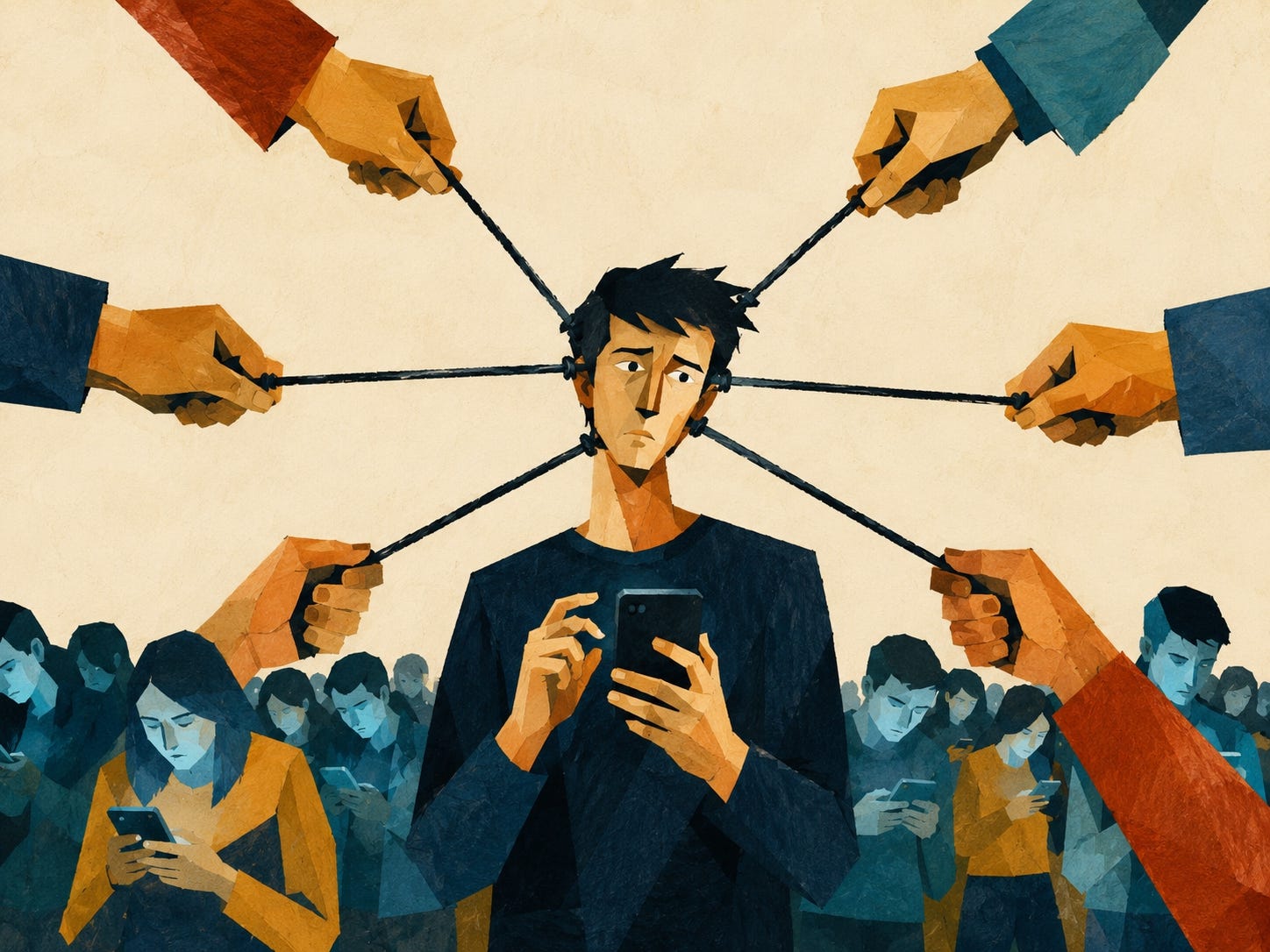
I think the first and most obvious change is that all apps are battling for our attention. Your attention can be converted into money. The better they know you and the more tricks they use, the longer you stay on the app. More time means more adverts.
This is especially bad with social media apps, but not only those. I recently tried to use a meditation timer, and it took about five minutes. I was asked to set my goals for the week, commit to a streak and reject premium membership.
It’s hard to stay focused. Your attention is under attack.
Nobody cares about your mental health
None of the popular scrolling apps care about you, your wellbeing or your mental health. They know it can be bad. They may even show you content with mental health advice. But in reality, they don’t want you to leave the app. They want you to keep scrolling so you learn so much that you have no idea what advice to follow, how to follow it or why.
It is hard to believe that an app designed to take advantage of your attention can also be good for your mental health. It’s a contradiction.
False control and autonomy
We all think our views are completely unique and independent, but whose views are we following?
I regularly hear people share information I previously saw online. I catch myself doing it too. We all think we are so sophisticated, but in reality, we’ve been fed information that’s become part of our views or even our identity.
You just need to interact with one opinion, group or interest to be fed more content confirming it. It quickly becomes part of your views or values.
Brain changes
My brain kind of hurts after using the app. I feel foggy. Processing so much information requires a lot of mental energy. And this doesn’t come without a cost.
Our brains constantly adapt and reorganise depending on what we repeatedly do. If you play tennis every day, your hand-eye coordination may improve. This is useful. But if you spend a few hours scrolling, your brain and body also adapt. Not only in the obvious ways, such as posture and physical inactivity. Your brain is struggling to process so much information at such a fast pace. How do you get better at it? Perhaps by becoming quicker at shifting from one thing to another. The problem is that sustained attention may then begin to feel harder.
Shortening attention spans
You often have only a few seconds to decide whether to skip a post, and only a few more for it to “hook” you. That’s why most videos nowadays start with the juicy stuff! It’s like clickbait or a movie trailer. Our brains adapt. We get better at it, but this comes at a cost.
So, what about our attention span? Research suggests that twenty years ago, the average time people spent on a single screen before switching was around 150 seconds, but this reduced to approximately 47 seconds in studies conducted more recently.
We contribute to each other’s misery
The app gives us the tools, but we’re the ones creating the content. We are all fighting for each other’s attention. Even if you escape classic social media, your attention is not safe. Try Substack. Half the posts I see are optimised to catch your attention. Many of the most popular accounts are dedicated to teaching you how to be a good Substacker and capture people’s attention successfully.
Yes, social media is fighting for our attention, but we are the proxies for it. We are the ones using the platform to capture each other’s attention.
If you’re an Instagram influencer, there is no point in posting a video that’s not optimised for Instagram’s audience. You have no choice but to try to “hook” people.
The social media app is the drug lord, you are the drug dealer, and we’re all the drug users.
Final words
This turned into a much longer post than I planned! If you’ve reached the end of it, you must have a decent attention span!
I think we’re far from the moment when the whole thing will go in a different direction. Our attention is under attack. We are being targeted by platforms that spend incredible amounts of money on research into how to make their products more profitable.
Leaving any addictive habit is hard. I am not even suggesting you should leave Instagram. It’s up to you. But if something were to motivate you to stop, or at least reduce your social media use, it would be anger at the people who design the whole thing.
It’s hard to justify using an app that invades our privacy, manipulates us, pushes opinions on us, can worsen our mental health, and reshapes our society for profit.
Yet, Instagram is still growing.
Maybe, instead of calling it social media, we should call it a passive entertainment platform.
👉🏼 Leave a comment
What bothers you most about social media?
What have I missed during my eight-year absence?
Thank you for reaching the end of this article.
I’m glad you’re here :)


