


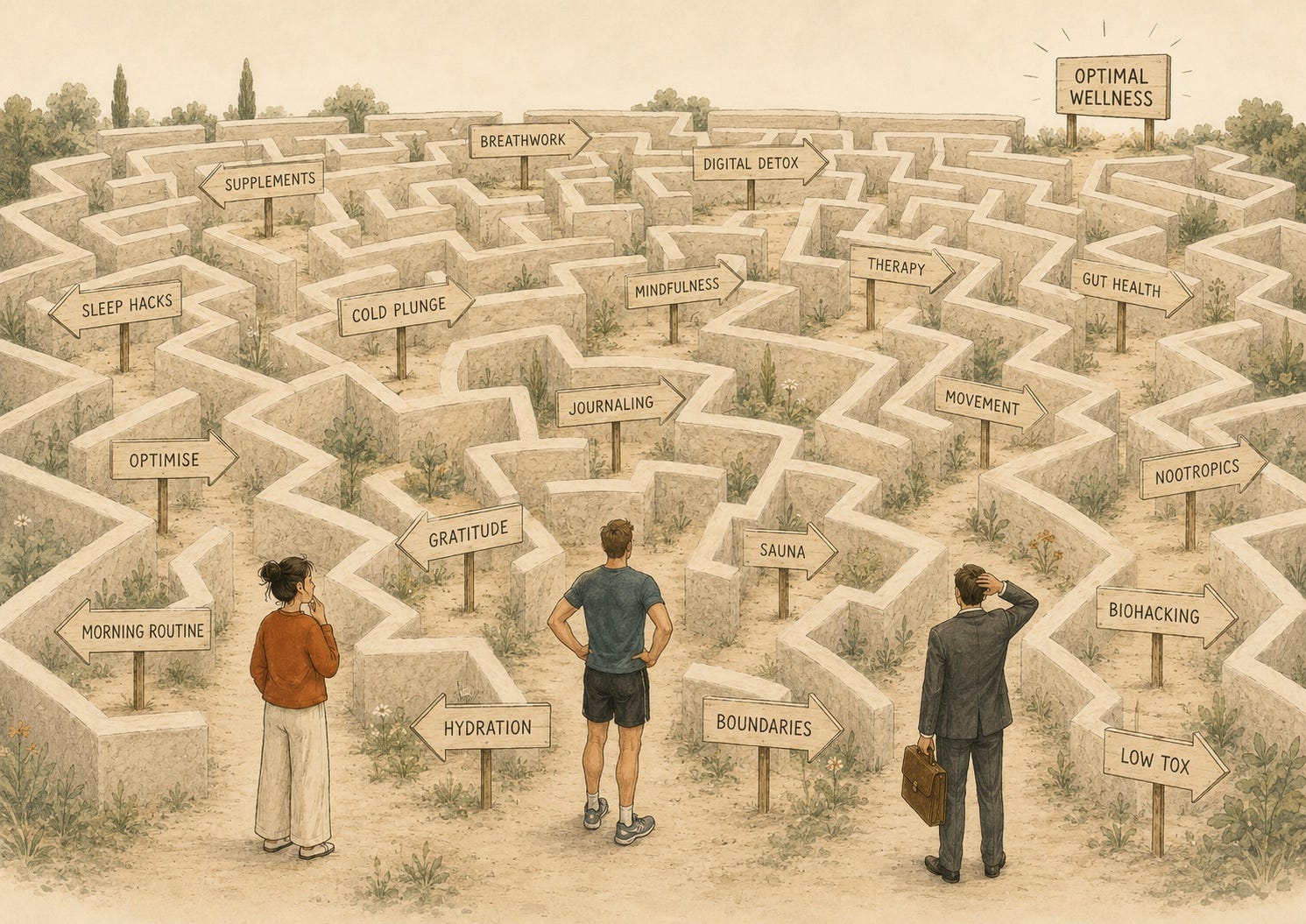
It’s 8am on Saturday morning. I am sat in the sauna in the local contrast therapy centre with a few other wellness enthusiasts. They’re now very familiar and friendly faces. I’ve become a regular.
I can hear peaceful music in the background, the sound of hot stones, and the occasional slamming of the sauna door as people come and go to take advantage of the cold plunge.
Whatever is happening with dopamine, endorphins, heat and cold - everyone’s mood seems to lift. The place very quickly turns into a pub-like experience, with jokes, stories, and interesting facts.
“Kuba, you’re a psychologist, let me ask you this question,” says one of them. His name is Steve. His face is now full of concentration and determination. I am curious.
“Why do we like this? Sauna… cold water…?” says Steve.
What a great question, I think to myself. I have a few answers circulating in my head.
“I think it’s because huma…” I start.
“Let me interrupt you here,” says Steve. His eyes are much wider now. This is followed by a longer monologue. At this point, I realise it was never about a question. It’s time to listen.
“Humans are not all the same. But we are told the same advice. Do we all experience benefits from this sauna and cold plunge or are we just following another fad?” says Steve, shrugging his shoulders. “I’m tired of all this wellness advice. Everything turns into a protocol. We are being told what to do, how to manage stress. We are told what’s good for us and bad for us. Everything is called wellness now.”
He continues for a few minutes. I bite my tongue a couple of times, thinking of the best angle to enter the debate. Another lad on my right joins in. His name is Matt. He is usually very good at offering a balanced perspective. Let’s go Matt!
“I think the modern world is…” he starts.
Steve leans forward again. He’s determined to make his point very clear, and so he continues. At that point, it’s been a while since I’ve cooled down, but I don’t dare to leave for the cold plunge for fear of missing out.
That’s how the debate started. Steve is a friendly guy, and I’m exaggerating slightly for dramatic effect. After the initial passionate speech, he lets us express our ideas.
It was a great thought-provoking conversation to start the weekend. And I think Steve made a very good point.
The wellness world has gradually turned healthy living into a battle with rigid and detailed step-by-step protocols.
Despite the growing availability of research and advice, many people still seem to feel more stressed and unwell.
I’m not sure we can fully blame wellness trends. But I think when wellness stops being useful and turns into an unrealistic set of rigid rules, the whole thing is starting to miss the point.
What’s the problem with wellness advice and protocols?
Many wellness ideas are backed by research. But even a good scientific study does not capture the uniqueness of individual people.
Despite researchers’ best intentions, each sample has variation. There may be people whose reactions are completely different from the average person in the group. Researchers may identify outliers and sometimes exclude them, but that is not the main issue. The bigger problem is that results are often reported at group level.
Whether this involves measurement before and after an intervention, or a comparison between a group with and without the intervention, it often relies on the average.
What is the conclusion from many studies?
“XYZ helped people on average.”
In other words, if the analysis suggests a statistically significant difference, it means that, on average, the intervention was associated with a measurable difference on that variable in that sample.
It doesn’t mean it helped everyone. It doesn’t even mean it helped in the way we hoped.
Other variables may not be tested, and people who experienced a different reaction may not be fully captured.
Despite this, I think research is useful. But it’s just a guide. Most of us are not walking through life as a group average, so maybe we need some flexibility.
What if there was no wellness advice out there?
I like to flip things on their head to make sense of debates. So let’s try it here.
What if there was no wellness advice at all?
Nobody would share tips or protocols. No YouTube videos, no research, no instructions, no data, no anecdotal stories.
The local therapy centre would probably have never opened. Today’s debate in the sauna wouldn’t have happened. So that’s the first downside.
On a wider note, it would take us longer to know what works.
Exercise technique, cooking tips, healthy diet, mental health tools, productivity systems. It can all be useful stuff. I don’t think it would be easy without it.
If it was all gone, we would need to get very curious again. Experiment. Observe. Notice. Mistakes would have to be made.
If nobody told you what food is healthy, how to breathe, or how to optimise sleep, you would have to discover it yourself.
How to best approach wellness advice
I do recognise I am touching on the idea of optimising optimisation, but for a good reason. I think optimising for a good life should be relatively simple. Maybe there is a way to find a minimalist approach to wellness?
The moment it turns into a complex set of rules to follow, it becomes stressful. And constant stress is not wellness.
I think worrying about the impact of stress and constantly optimising for low stress is a common way to develop chronic stress. Stress is a signal that helps us achieve certain goals. If one of those goals becomes “I must be less stressed”, things can get complicated.
Relaxation becomes a performance target. Not exactly relaxing.
So how can we make wellness advice less stressful?
I think it’s by combining two apparently contradictory points into one.
Wellness protocols and advice can be very helpful.
Humans are unique and don’t fit neatly into protocols.
How can both be true at the same time?
For this to be possible, we need to be able to extract useful information from any protocol or advice but not lose ourselves in the process.
The only way is to see any wellness advice as an option or guide.
The main thought being:
“Here is something someone tried, and it works for them.”
Then, based on your personal history, experiences and goals, you may need to decide whether you personally feel it’s worth experimenting with this particular tool. And even if you do try it, would you continue using it if you can’t observe any obvious benefits?
For me, the process looks like this:
Learning something new -> is it for me? -> Moving on or experimenting -> Observing, noticing, reflecting, adjusting.
I don’t mind learning about new wellness trends and tools. I quite enjoy reading books or listening to podcasts. But I always try to apply some flexibility to it. I don’t blindly follow any of the advice. In fact, doing so would be impossible.
Social media plays a big role in wellness trends. The internet is oversaturated, and with short-form content becoming the new normal, you will see a new piece of advice every few seconds. People end up following trends and often promoting them, without fully understanding the mechanism behind the given tool.
Instead of observing our bodies, learning to notice and reflect, people end up doing what “looks cool” on social media.
Getting a good night’s sleep and not telling anyone about it is definitely much better for you than a slow-motion ice bath video with 67 likes.
How do you know if a given tool is working?
I find that one of the ways to decide whether a new tool is working is to observe your reactions, especially stress levels.
If your nighttime routine stresses you out to the point you can’t fall asleep, something’s gone wrong.
If your new exercise programme, designed to improve your energy, causes you to crash for six hours, then clearly it doesn’t agree with your body.
If you tried cold plunge because you’ve heard it can improve your immune system, but you get ill each time after, then perhaps you need to try something else, or at least experiment with modifying the duration or temperature.
I don’t know if there is such a thing as an optimal lifestyle or routine. Your nervous system doesn’t have a dashboard. There are simply too many variables that change every day, every hour, every minute. Your body is a flexible system, adjusting all the time. What works today may not work tomorrow.
Observing your own body and emotions is key to developing a healthy relationship with wellness tools. There is no point filling your day with endless rituals. Your life will become about tracking and optimising.
If you spend all your time trying to live better you may end up with no time to actually live.
So maybe, let’s just aim for a minimalist approach to wellness.
Stay curious and keep learning. Add some flexibility. Don’t treat each new tool as a “must”. Practise letting go of those that take too much out of you.
Can you condense your approach to a few simple things that work most of the time?
If you do, please let me know. I’ll personally thank Steve and Matt for starting the debate that inspired this article.
Thank you for reaching the end of this article.
I’m glad you’re here :)

You might also like:


IMO, sometimes what doesn't move solidifies. What doesn't flow usually gets stagnated and becomes the very thing it tries to fix.
You nailed it on the head when you said, "Humans are unique and don’t fit neatly into protocols." When I was diagnosed with diabetes the doctors all told me the same thing on how to manage it. Nothing they told me worked. I had to learn the hard way that humans are all different and you have to do what works for you.
Thank you for this article. It was a great read!