


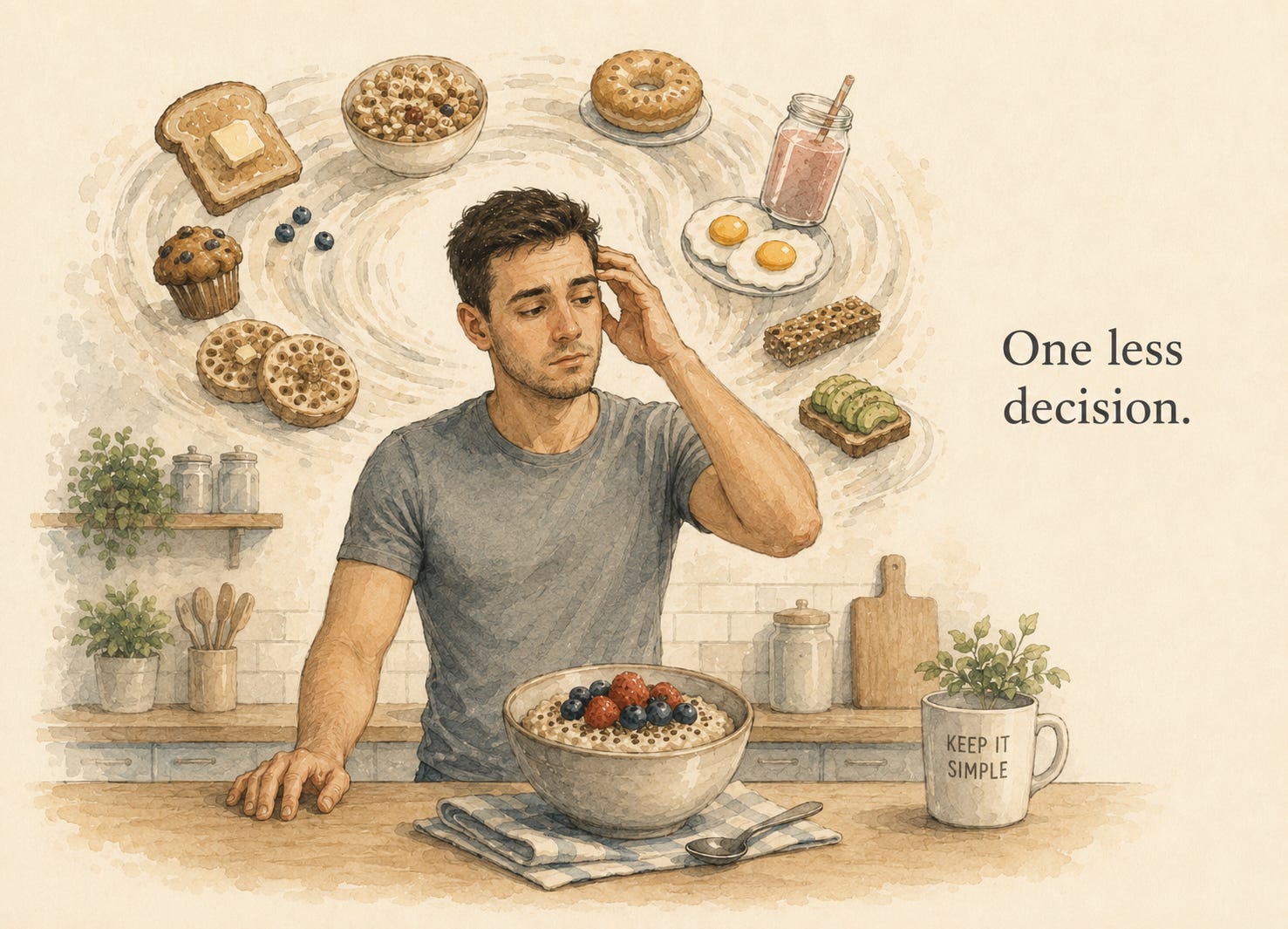
Living healthy sometimes feels like the easiest task in the world, and at other times it feels confusing.
Breakfast is one of the topics where it is easy to be misled by various opinions online. The advice is endless, often contradictory, but usually expressed with 100% confidence. The more you learn, the harder it is to know what is “correct”.
I don’t recall breakfast ever being analysed in detail in childhood. Most kids consumed Nesquik or Chocapic, and the only debated topic was whether or not the milk should be warmed up.
I think it’s good we’re talking about it now, but I wish we could simplify it.
The first issue is whether breakfast really is important or simply something to skip because of all the claims around fasting and autophagy. I may write about this another time. Today, I have kind of unintentionally placed myself on one side of this debate already.
The issue of morning decision-making
This thought has been playing on my mind for a few weeks now. Why not just make life simple, identify a healthy and reasonably optimal meal, and go on auto-pilot mode every morning?
Apart from the risk of boredom, I quite like the idea.
Time in the morning is very precious. Removing clutter and any unnecessary tasks helps to create space for things that matter. Without a good plan and with limited time, it’s much harder to make good decisions. Entering your kitchen with only 6 minutes to spare means probably going for the easiest and fastest option available. Quick toast, pastry, granola, crumpets with butter, ultra-processed protein bar?
I think having a clear idea of breakfast options can resolve the problem of mindless and rushed decisions.
And if there was a way to simplify it further, then why not?
Why waste time worrying about breakfast options?
I would absolutely hate to find out one day that the food I chose as my one and only breakfast was bad for me, or simply a waste of time. Putting some effort in now, so the next few years of my life can be a bit healthier, sounds like a decent idea.
I am aware there is no guarantee. I’m not looking for perfection either. A reasonable and informed choice is good enough.
Nutritional trends change every few years. It’s possible that in 2040 we’ll be laughing about our current choices. My friend and I have a rolling joke that one day a new study may come out suggesting harmful effects of avocados, which currently are probably a symbol of healthy living.
It has already happened, to some degree, with coconut oil, margarine, fruit juices, smoothies, granola, low-fat yoghurts, rice cakes, veggie crisps, protein bars, diet drinks, honey, dried fruit, and I could keep going. So… no choice is completely safe!
The below is my personal reflection, but as always, let’s not forget how unique we are, and how differently we respond to different foods.
Breakfast options and preferences
I personally find that anything sugary or carbohydrate-heavy is probably the worst thing for me. It doesn’t feel like real food, and it sets me up for a sugar crash later in the day. I am more likely to crave a snack and generally feel more dysregulated.
For this reason, I am ready to cross out cereals, granola, instant oats, pastries, crumpets, and bread.
But I also think the activities I engage with require fuel. I work with highly emotional content in therapy with my clients, and I exercise quite heavily. My brain and body both need steady energy. So, for me, completely avoiding carbs in the morning does not feel like the right answer. I just need to avoid the crash.
I probably should aim for higher-protein, maybe combined with a slower-release carbohydrate option or something that slows down its absorption. I think rolled oats mixed with other ingredients sounds like a good candidate.
I’ve tested many options, including morning salads, gut-friendly beans, and ambitious shakshukas. But despite good intentions, I generally find myself cycling through two or three easy meals: either oats with protein yoghurt, berries, nuts and seeds, or an egg-based meal, sometimes with added avocado or other greens.
Over time, I started naturally gravitating towards the former.
Optimised overnight oats
If I prepare my oats in the morning, I cook them. That’s why I prefer the overnight version. It saves time. I usually mix them with a good portion of high-protein unflavoured yoghurt, such as Skyr or Greek yoghurt. I add some water too, otherwise it can turn into cement. Then I experiment with different ingredients: flaxseed, chia seeds, various nuts and seeds, blueberries or cherries, and even a sprinkle of cinnamon on top.
When I think of a good start to the day, this is where my mind goes. It gives me energy and clarity, and it doesn’t get in the way of my productivity.
It’s easy to make and it seems to cover most of what I want from breakfast:
High protein? Tick.
Carbs? Tick.
Slower-release energy? Tick.
Fibre? Tick.
Vitamins? Tick.
Antioxidants? Tick.
Healthy fats? Tick.
Gut-friendly? Tick.
Have I found my guilt-free, no-faff, all-in-one meal?
Possibly.
Is it perfect?
Unlikely.
Am I okay with that?
I think so.
What if oats are bad for you?
I’ve previously read suggestions that oats cause inflammation. Luckily, the 2021 meta-analysis (a summarised analysis of many studies), did not support this idea.
And with oats being one of many ingredients in this meal, I am not too concerned. But I am ready to be wrong and adjust where needed.
Benefits of eating the same meal daily
The main benefit of eating the same meal daily is simplicity.
It takes me less than 5 minutes to prepare in the evening and it’s ready for me in the morning when time is limited.
Shopping is easy. All I need is a big bag of rolled oats, cinnamon, and natural high-protein yoghurt (e.g. skyr). I regularly top up my freezer with frozen berries and my cupboard with a variety of nuts and seeds. All the ingredients usually have long expiry dates, meaning I’m not wasting much food either.
The meal keeps me full until lunch. I don’t snack or crave food. If I have a busy day at work, I find it gives me a good spread of energy, with no crashes. My concentration is not affected, allowing me to focus on my clients or other activities.
It agrees with my body. No bloating, no discomfort.
It helps with exercise. It supports my muscle recovery and helps with fuelling my late morning workouts.
It tastes good.
I don’t get bored of it. And if I do, I can be flexible. I can modify the ingredients: different berries, fruit, nuts, seeds, and so on.
I don’t need to worry about nutrition. I can leave decision-making for more important tasks.
Should I eat the same breakfast every day?
I’m not planning to eat the same breakfast daily for the rest of my life. This is not a New Year’s resolution or an attempt at making my life more rigid. It’s kind of the opposite. Whenever I feel more creative, I have more time, I am away, or I simply crave change, I can eat something different. No issue here.
If I was forced to choose one breakfast for life, it would probably be the above. I can’t imagine eating a bacon sandwich, sausages, or other heavy meals as my daily default option. Even egg-based options are something I go off easily. Eating scrambled egg two days in a row often results in my body telling me, “No more please.”
And I think forcing myself to eat something nutritious that I don’t enjoy would probably be the worst outcome of this conversation. It wouldn’t work anyway. I am trying to make my life simpler, but not at the cost of enjoyment.
What are you trying to make easier?
So, can you eat the same meal every day?
Of course you can. And if your choice is reasonably nutritious, there are probably many benefits to keeping things simple.
You can also start every morning by baking a cake if that’s your thing. I’m not into the idea of telling people what to do.
If you’re weighing your options and trying to achieve some form of healthy breakfast minimalism, here are some ideas for you.
Try to opt in for something nutritious.
I’d also ideally like to make sure you get a decent portion of protein.
Make sure it’s a meal you enjoy.
Aim for something that agrees with your body.
But most importantly, do what you can to be consistent with the kind of person you want to be.
What are your life goals?
If you love cooking and experimenting in the kitchen, amazing. Embrace it. Allowing your creative side in the morning would probably set you up nicely for the day.
If you prefer fasting and have noticed benefits from skipping breakfast? Great. Keep going. Don’t make yourself more sluggish if you have a no-breakfast routine that works for you.
I think consistency is important. I’m not talking about regularity, although that matters too. I mean being consistent with your goals. Optimising health is an important goal, but so are others. Minimising wasted time. Minimising wasted food. Recovering from workouts. Cognitive performance. Enjoyment of different foods and activities. They can all influence your decisions about how to approach breakfast.
I am aware some people’s philosophy is to simply enjoy life and not overthink health decisions. I think that’s reasonable, and I have no problem with that. If a sugar-coated cinnamon bun with a caramel latte for breakfast goes well with your current perspective and life goals, please don’t be influenced by my perspective.
But if you’re aiming to make some small health changes and you are unsatisfied with your current decisions, it’s worth pausing and asking yourself:
What’s the easiest way I could simplify my morning choices?
Putting some effort in now could change how your mornings feel, potentially for the rest of your life.
Thank you for reaching the end of this article.
I’m glad you’re here :)

You might also like:
Stress Is Good for You. Kind of.

The strange world of hormesis, resilience, and why stress can train us or drain us, depending on dose, meaning, and recovery.
I Tried a Dopamine Detox. Then I Got Excited.

Why cutting out stimulation can help for a while, and why treating dopamine like the enemy misses the point.
Is Afternoon Coffee Bad for You?

Reflections over a flat white on caffeine, sleep, and conflicting life goals. How much does it help? How much does it cost?
Why Rest Can Feel Harder Than Work

Why stopping can feel tiring, even when it is exactly what we need.
Nice, we do kind of the same—which is hardly any mainstream advice. My wife studied for years and came up with a fixed system, pretty counterintuitive to a lot of what's online; it looks like this: colostrum and probiotics first thing, 30 mins later we run a set rotation of low-carb breakfasts across the month, no caffeine or sugar, pretty automated, then the gym a bit later. The framework we tend to match best with is Ayurvedic—so far so good. I hope it keeps working for a very long time. We live in a desert, so it's tougher for us than if we lived in the rainforest, where I'm from originally.
I've eaten the same breakfast for long stretches before, so this made sense to me. Keeping it simple can make life a little easier