


The first time I went to the gym, I could barely walk for a few days. But I went back.
When I was asked to lead the school assembly at 11 years old, my whole body was telling me to hide. But I stayed.
The first time I stepped into cold water my brain shouted at me: “This is irrational.” But I continued.
Each of the above examples are good examples of internal conflict. Our body signals one thing, but we do the opposite. Usually because some underlying value or goal matters more than the short-term discomfort.
Experiencing stress in these situations gave my mind and body a chance to adapt and grow. Gym workouts became more enjoyable and easier to handle, cold became more tolerable, and public speaking became more natural over time.
But what if my mind and body learned the wrong thing from it?
Pain from the gym could mean exercise is dangerous, so never go again. Cold water hurts, so it’s best to stay warm and cosy instead. Public speaking feels uncomfortable, so why risk embarrassment?
Avoiding pain and discomfort makes perfect sense, especially in the short-term.
Staying in Control Now
Your body’s first goal is usually to help you stay in control right now.
It directs your attention and resources towards whatever seems most important in the moment.
One of your goals in life might be to relax in the sun and enjoy yourself. But if you’re being chased by a tiger, your priorities suddenly change. There’s no point enjoying the warmth of the sun or planning your shopping list while trying not to die.
Similarly, during a job interview, your brain is unlikely to focus on your retirement plans or analyse yesterday’s gym workout.
We naturally prioritise what’s directly in front of us. This is often driven by built-in fears and protective responses.
Living organisms constantly try to maintain balance and stability - a process called homeostasis. For example, if you get cold, your body tries to warm you up, until temperature returns to its baseline. The same process occurs at an emotional level.
However, restoring control can lead to very different outcomes. To simplify it, let’s just focus on two options.
Option 1: short-term problem resolution👍🏼 → but… long-term problems. ☹️
Option 2: short-term problem resolution 👍🏼 → and… long-term growth 💪🏼
Despite achieving positive results in front of you, the long-term outcomes can be totally opposite.
Good stress trains us.
Bad stress drains us.
By the end of this article, you should have a better idea of how to optimise stress for long-term growth.
The Paradox of Short-Term Pain
Imagine explaining the idea of regular gym workouts to someone who has never heard of exercise.
“To improve your health, you’ll repeatedly do activities that hurt your muscles. You’ll be in pain, become sweaty, physically uncomfortable, and out of breath. Stress hormones will increase and your muscles will experience damage. This is good for you.”
It sounds confusing.
But this is exactly why many people avoid stressful activities.
We instinctively avoid discomfort.
Modern life makes this even easier.
Avoid boredom with scrolling.
Avoid tiredness with caffeine.
Avoid hunger with snacks.
Avoid awkwardness with distraction.
Avoid effort with comfort
The problem is that avoiding all discomfort can create a much deeper form of conflict underneath. Sometimes discomfort is the price of moving towards the things that matter to us.
Constant attempts at restoring control in the moment is what often gets in the way of our life goals.
Homeostasis Is Cool. But Have You Heard of Hormesis?
The body and mind don’t only aim to restore control in the moment. They also reorganise themselves to handle similar situations better in the future.
Once muscles experience microdamage from training, they repair and grow. The nervous system adapts too. Things that once felt stressful can gradually become manageable, familiar, or even enjoyable.
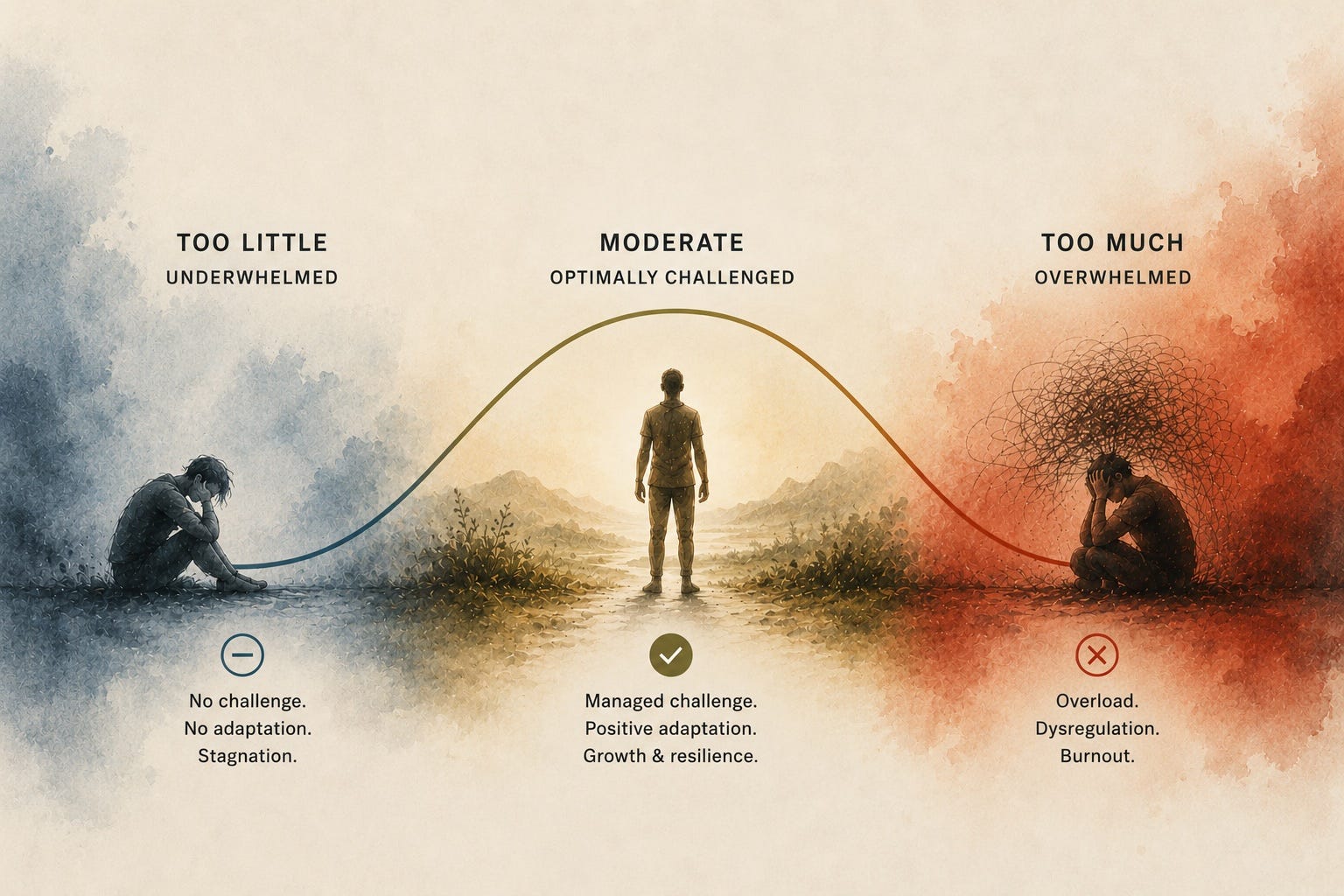
Hormesis is the idea that manageable amounts of stress can trigger positive adaptations in the body and brain.
All we need to figure out now is: How much stress is “just right”?
Too little stress and we can become deconditioned or stuck. Too much stress and the nervous system can become overwhelmed, pushing us into survival mode. Helpful stress seems to exist somewhere in the middle, where challenge is manageable enough to lead to growth, resilience, and adaptation.
Too little - no adaptation, stagnation, deconditioningModerate - beneficial adaptation and growth 💪🏼
Too much - overload, burnout, dysregulation
I’ve experienced this myself the hard way.
A few years ago, there was a period where I pushed my body beyond its limits. I used heavy gym sessions as a break from stressful work, but in reality, both were overloading the same nervous system. I combined intense exercise with caffeine, cold plunges, conferences, new projects, and other forms of stimulation.
All of the above are great and beneficial activities. But only in the right dose, at the right time, and in the right circumstances.
I eventually learned to pay more attention to recovery.
If my body is rested and ready, a difficult workout can feel great. But during more stressful periods, sometimes it’s healthier to slow down.
One of the main signals you’ve pushed your stress too far, is when you notice it gradually leads to worse outcomes. Another signal, is when you notice there is no time to recover before the same system is stressed again. This is true for any domain including physical, emotional, and social.
Psychological Hormesis
Many therapeutic approaches, whether explicitly or not, treat emotional avoidance as part of the problem. It makes sense why. Avoidance usually reduces emotional pain in the moment. But over time, it can weaken your emotional functioning.
Avoiding sadness, for example, can strengthen the belief that sadness itself is dangerous.
Eventually, the emotion becomes stressful.
You become stressed about feeling sad.
We discussed a few examples of going too far with physical stress. But hormesis also applies psychologically. In fact, many forms of therapy rely on it.
Approaches such as gradual exposure therapy or trauma-focused work often involve intentional opening of unpleasant emotions.
That’s why, instead of suppressing emotions, your therapist may help you experience them safely, talk about them, and understand them. You temporarily allow difficult emotions, thoughts, images, or memories into awareness.
The idea is, you experience manageable stress so the same thing stops overwhelming you in the future.
Is This Always True?
As a therapist, I am not the biggest fan of general statements such as “Never avoid emotions” or “Stress is good”.
I believe that avoidance and emotional suppression are perfectly fine emotional tools. I guess what I’d like to happen, is for people to make such choices more consciously, with better awareness of the “full package” of short-term and long-term factors involved in the given decision.
How to Optimise Stress for Growth?
Not all stress builds resilience. Some stress simply overwhelms the system. The body will always try to adapt, but adaptation does not always mean growth.
Alcohol, for example, acts as a stressor and toxin. Over time, the body adapts, meaning tolerance can increase. But that doesn’t mean alcohol is improving wellbeing (see my article about alcohol HERE)
Sleep deprivation is another example. Missing sleep stresses the body and brain. You might temporarily adapt through adrenaline and increased nervous system activation, but chronic sleep deprivation is strongly linked to negative physical and psychological outcomes.
There are many other examples:
pollution, abuse, chronic loneliness, smoking, ultra-processed food, repeated concussions, long-term uncontrollable stress.
There is no point exposing yourself to harmful things unnecessarily. Instead, we should engage in challenges that allow the body and mind not only to recover, but sometimes to grow beyond their previous baseline.
So it’s about choosing the right activities, in optimal quantities, and in the right context.
Sunlight exposure may have hormetic effects in moderation. But excessive exposure increases risk and damage.
Fasting for 14-16 hours may be adaptive for some people, but could result in underfueling for others. Starvation is never good.
Exercise can be one of the best things you do for your health. But intense exercise while already depleted can become another source of overload or burnout.
→ Context matters.
→ Recovery matters.
→ Dose matters.
We’ve all heard the phrase: “What doesn’t kill you makes you stronger.”
Sometimes it’s true. Sometimes it really is not.
Stress may become useful when the body and mind can still maintain some degree of stability and control. Beyond that point, stress can stop being adaptive and start becoming destabilising.
Growth doesn’t come from avoiding all discomfort.
It also doesn’t come from overwhelming yourself.
Learning to find the optimal middle ground is probably the best way to optimise for physical, emotional, social, and professional growth.
Thank you for reaching the end of this article.
I’m glad you’re here :)

You might also like:
I Became Obsessed with Cold Plunges. Here’s What I Learned.

I was always impressed by people swimming in ice cold water. When I was a kid I first learned about it on the Polish news. My TV back then only had about five channels.
The news reporter was half-smiling when describing a story of an annual winter gathering of cold wa...
Why Rest Can Feel Harder Than Work

A couple of weeks ago I took a few days off work. I wanted to let my mind and body rest, spend time with family, and enjoy local cafés and restaurants. But I also visited a dentist, got a blood test done, picked up a prescription, caught up on some reading, listened to a new audiobook, and completed a few other tasks. I also found myself spending more t…
The “Wine Is Healthy” Story Returns

A couple of years ago my neighbour was turning 80. I knocked on his door, ready to say happy birthday over the doorstep.
Before I could blink, I was already sat on his sofa with a glass of red wine in my hand...
Is Afternoon Coffee Bad for You?

There is something very special about coffee.
And probably only coffee drinkers can relate.
Everyone has their own reasons for consuming it. Some rely on it to manage sleep deprivation, some simply enjoy the ritual, others seek additional...
You make some good points here. There is a hidden cost to too much comfort. Nassim Taleb would call it fragility.
Also reminded me why I like running experiments. Following a generic health advice like “do ice baths every morning” is like gambling. It may work. It may not. I think we can all do a better job at being present with ourselves, listening to how our body responds to situations, and finding the right balance (and dose of stress).
Love this perspective, Kuba. You hit on a massive truth….our systems don’t care about our distractions, they just keep score. Because we’ve become so dopamine dependent, we endlessly chase short-term comfort just to avoid a few seconds of silence or boredom. We think we’re relaxing with a screen, but down underneath, the nervous system is still redlined. It’s a beautiful reminder that real growth and recovery only happen in the quiet spaces between things—if we can tolerate the silence long enough to let it happen. Great piece!!!!!