


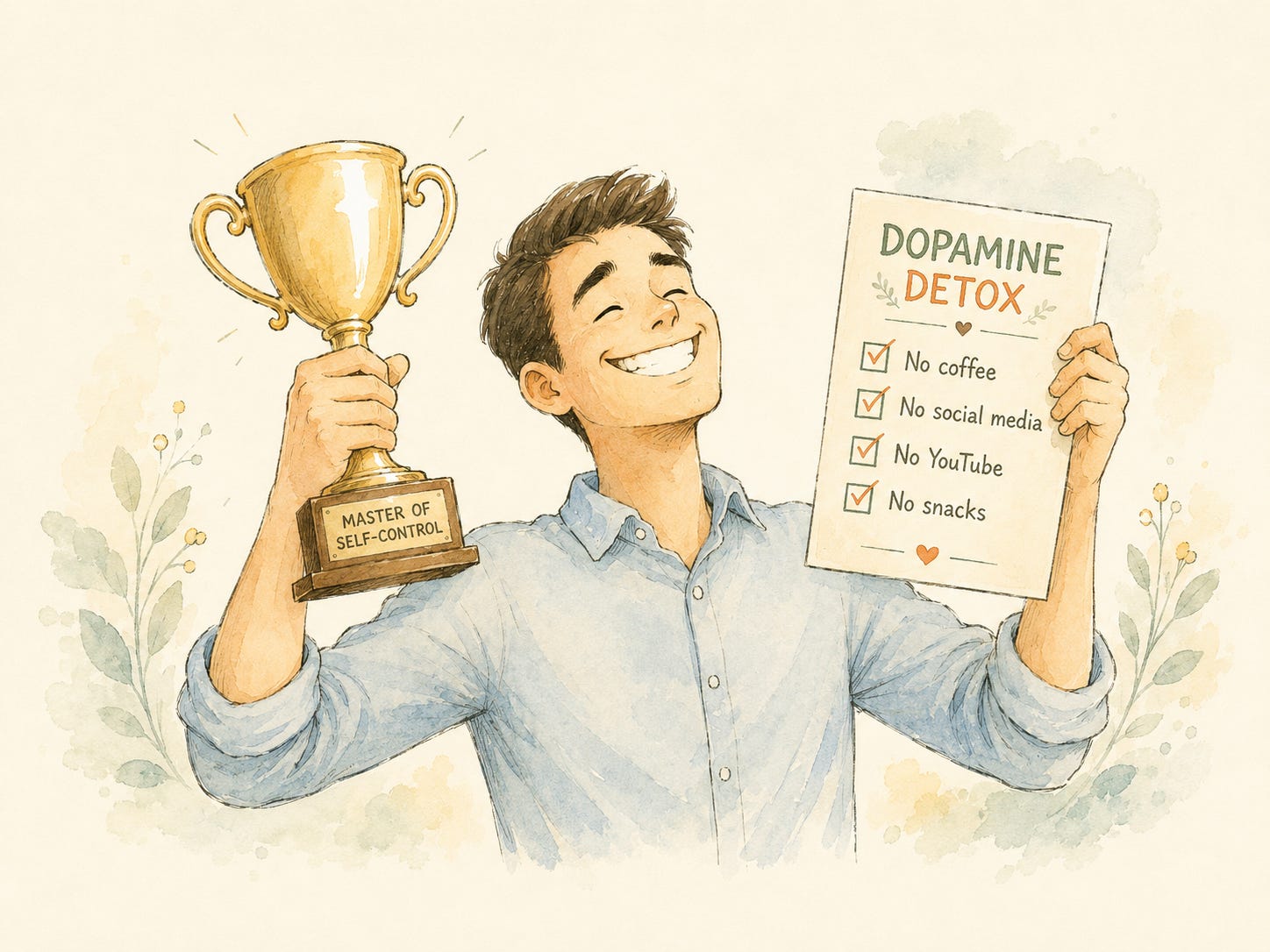
A few months ago I tried doing a dopamine detox.
No coffee.
No loud music whilst exercising.
No YouTube.
No social media.
No podcasts while driving.
By day three, I was already noticing some positive changes. It made me feel good. I started thinking: “Maybe I can make it last a full week? Maybe even a month?”
I like a good challenge. This idea got me excited.
And then I paused.
If I am excited... does that mean my dopamine is high?
What kind of dopamine detox am I doing if I am spiking my dopamine by avoiding dopamine?
This felt like a confusing but interesting thought. So I started exploring it.
I met with my close friend for a coffee. Decaf, obviously. I’m on a detox, right?
We started chatting and it felt like an amazing intellectual exercise. He started challenging some of my ideas about wellness activities, including the current detox. My neurons were firing. By the end of the conversation, I was feeling motivated, inspired and curious.
Then I stopped.
My dopamine must be spiking again. Was I failing at my dopamine detox?
Or was it exactly what was meant to happen?
A few weeks later, I started diving a bit deeper into the theory and research behind dopamine. Once I made sense of it, I started looking at dopamine detox from a completely different angle.
I can’t wait to share it with you!
Sorry. Dopamine spike again…
Is Dopamine Bad?
I won’t bore you with a complex definition of neurotransmitter activity and how the reward system works. There’s a high chance you know some of it already.
Scientists explore ideas such as equilibrium, homeostasis, and allostasis. But I’d like to use simple language, to make this as easy as possible.
Our bodies follow a system.
Your body is always trying to regulate itself. It’s aiming for stability, but with constant adjustment.
For example, when a signal is sent that you’re too warm, you start sweating and craving a cold drink. Once your base temperature is restored, you stop sweating.
The same general principle applies to many internal systems, including the ones involving dopamine.
A common view is that dopamine is “high” when we feel good and “low” when we feel bad. But in reality, dopamine is constantly involved in motivation, learning, and how we respond to cues in the environment.
So when people talk about lowering, resetting, or detoxing from dopamine, the idea gets a bit confusing.
Dopamine itself is not a toxin you can flush out of your body, so technically we can’t detox from it. It’s part of the system, and it always will be. It is part of being alive.
Logically, we shouldn’t be detoxing from something that keeps us going. Imagine trying to detox from appetite, sweating, pain, or even your heartbeat.
All of the above, like dopamine, go up and down, depending on the circumstances.
What Actually Happens During a Dopamine Detox?
We’ve already identified that being excited about a detox is a confusing paradox. But this is just the beginning of the contradictions.
When you stop engaging with all the things that normally capture your attention, your usual reward cues disappear. You may very quickly feel bored. That’s when a signal is sent that “something is wrong”.
The usual cravings for TikTok, coffee, and stimulation don’t go away just because you’ve decided to do better this week. If anything, they may get louder.
Your system is aiming to return to its usual level of stimulation. If the usual methods don’t work, the signal intensifies. Mild cravings turn into something hard to resist.
This feels like a contradiction. We hoped that a process of internal reorganisation of priorities happens quickly so that we become more interested in normal daily activities. But instead, the craving for the unwanted activity got worse.
Reorganisation can definitely happen in the long term though.
But the first effect is often the opposite.
What Happens After Some Time?
If you stick to low stimulation activities for long enough, often a few days to a couple of weeks, simple things can start to feel more enjoyable again.
A walk.
A conversation.
A book.
Cooking without a podcast in the background.
This is exactly what you wanted, right?
But here comes the next problem.
If a normal activity starts to feel rewarding again, what happens when a highly stimulating activity becomes available again?
Talking about baking is much less likely to make you eat a slice of cake than having the cake right in front of you when you’re hungry and depleted.
At that point, the pull is much stronger. You may end up destroying the cake before you have time to question your life choices. The same mechanism occurs here. The signal gets stronger.
What Happens When the Detox Ends?
Let’s assume your willpower helped you to stick to your plans and you managed to resist. Great! But… unless you’re planning to live like a monk for the rest of your life, your dopamine detox will have to end at some point.
Have you seen the video of Michael Pollan talk about his first coffee after a few months off caffeine? He described it as a “psychedelic” experience.
I’ve previously tried a six months of caffeine detox myself which I concluded with a double espresso at 7am. It was probably one of the most joyful, creative, and productive work days I’ve ever experienced.
Basically, when something rewarding has been removed for a while, returning to it can feel even very powerful.
Is that good or bad? Both.
Ordinary activities can feel more enjoyable again. But highly stimulating activities feel like ticking dopamine bombs.
What once felt normal, like morning coffee whilst scrolling TikTok, can suddenly feel like a much bigger hit.
And because, unfortunately, it’s not possible to avoid all stimulating activities, at some point you will be forced to engage in one.
When Stimulation Comes Back
We’ve all heard of the yo-yo effect when it comes to dieting. My understanding is that something similar can happen here.
If you suddenly engage in 2h of scrolling. You will experience a big spike of stimulation. When that happens, your body and mind don’t just sit there calmly saying, “lovely, thank you very much”. The system responds. Once the rewarding activity ends, you may feel a drop. Less motivation. Less interest. More craving. More restlessness.
There are many versions of this happening to all people, and not just those detoxing,
Artists sometimes feel flat after performing on stage.
Holidaymakers experience holiday blues.
Coffee drinkers experience afternoon crash in energy.
In extreme examples of stimulant drug use, people can experience a comedown for a few days.
Things get problematic here. When your mood, motivation, and energy are low, cravings can return. Your attention gets pulled towards everything you have just taken a break from.
And here we are again, back at the beginning.
So… if you end up listening to your cravings, you’re back on the dopamine trip. If you resist, you may be left with low mood, low motivation, and other unpleasant symptoms. If you continue resisting, you may be pulled elsewhere: snacks, work, cleaning, checking emails, researching productivity systems, or reorganising the spice cupboard at 11pm.
When the system becomes unstable, you end up experiencing higher highs and lower lows.
Is There a Better Way to Approach Dopamine Detox?
Our bodies are very good at adapting to new circumstances. We build tolerance to alcohol, caffeine, and medication. We can also get desensitised to emotional situations, for example using exposure therapy. But we need to have a good idea of what we are trying to desensitise ourselves to, and why.
If a classic dopamine detox can create a yo-yo effect, then maybe we need to take a lesson from the typical solution to the yo-yo effect.
We are aiming for sustainable change.
This will be very boring, but...
We need a clear long-term goal that is consistent with our values.
Avoiding all pleasure leads to a very miserable life. There is definitely value in spending more time in nature, away from technology, and away from stimulation. But is that what you want?
We’ve all heard amazing success stories of people who moved to a different country, escaped the 9-5 life, and now spend most of their time walking barefoot in the forests of South America. But… for you to hear these stories, dopamine must have been involved. Otherwise, why would these people share it on Instagram daily?
So before you engage in a dopamine detox, it’s probably worth reflecting on your goals and what you’d like to happen after your challenge is completed. It’s not possible to avoid all stimulating activities. For example, deleting TikTok doesn’t mean you’ll never see short-form engaging videos again. The internet is full of them. Even if you don’t mean to, at some point you may get sucked in. And what will help keep yourself in check if not your goals and values?
It is often recommended you follow the dopamine detox with clear lifestyle changes. This is probably a good idea. For example, after completing the detox, you might delete the TikTok app and never use it again. Instead, you might use a Kindle app to read books.
Before we fully conclude how to best approach a dopamine detox, let’s summarise what we established so far.
What Are the Lessons Here?
We don’t want to remove dopamine, reset the brain, or “balance” a neurotransmitter we don’t fully understand. But the idea of dopamine fasting (instead of dopamine detox) is probably reasonable.
So let’s clarify a few important points.
→ Dopamine is not simply a “feel good” chemical. It is heavily involved in motivation, wanting, learning, and anticipation.
→ You don’t run out of dopamine from too much stimulation.
→ Changes in reward sensitivity don’t magically reverse in a few days.
→ Dopamine detox won’t recalibrate your reward system in a lasting neurological sense just because you avoided pleasure for a weekend.
→ Without a systemic change in your lifestyle, goals, environment, and values, you will probably return to the previous pattern.
→ It can create an unhealthy relationship with pleasurable activities. You get pleasure either way: from engaging or from avoiding. It can become very all-or-nothing.
What Should We Do Instead?
Let’s start by accepting that dopamine-related spikes are perfectly normal parts of human functioning. If they’re here to stay, we need to decide what we would like to be pulled by.
If the given activity is consistent with your identity, values, and vision of the future, the system is happy, and dopamine spikes are helping you achieve your goals.
For example, if you value long-term financial stability, there is nothing wrong with subscribing to a newsletter about passive long-term investing. When it arrives in your inbox, it may trigger interest, anticipation, and motivation. The spike is connected to something meaningful. It helps you learn. It connects to your future goal of a financially secure retirement.
If, however, you are consuming endless content about becoming rich overnight and cryptocurrencies going to the moon, you may be turning away from your actual goal.
Your dopamine system is still involved. But now it is being pulled by the fantasy version of the goal rather than the real one.
This can lead to more dysregulation, more cravings, and potentially impulsive financial decisions that risk your long-term goals.
Let’s try another example.
Imagine you’re spending 2 hours per day watching educational content about productivity.
What’s your goal?
You might need to ask yourself:
→ What’s important about productivity?
→ What’s important about that?
→ What’s important about what’s important about that?
Once you get to the bottom of your conundrum, it becomes easier.
The final answer might be any of the following:
“I want to be someone who changes the world for the better.”
“I want people to like me.”
“I want to impress my parents.”
“I want to increase the output in my business.”
Depending on your answer, you might need to replace the false productivity videos with something that actually brings you closer to your goals.
Once you have made your mind up about what is important to you and how to achieve it, you can use additional tricks. I am usually not the biggest fan of telling people what to do. I’ll briefly mention some ideas, but it’s up to you what you do with it!
One helpful trick is adding friction. Here is some I’ve tried .
Log out of the app after each use. Re-entering your password can kill the impulse.
Move the phone charger away from the bedroom. Using your phone at night or in the morning would then require more effort.
Turn off notifications for most apps.
Don’t keep your favourite snacks at home.
Use website blockers with a 1-minute delay.
Wear trousers without pockets. It forces you to keep your phone in the bag. (I’ve not tried this one yet!)
At the same time, it’s worth reducing friction for your desired activities.
Have a big water bottle, so keeping hydrated is easy.
Create a minimalist bedside shelf with only one book on it - the one you’d like to read.
Or, if you’re looking for desperate measures, sleep in your sports clothes to make the morning run more likely to happen.
You can use a short break from stimulation to interrupt a pattern. But interruption is not the same as new learning. You’d need to gradually adapt your approach, making it more sustainable.
The aim is to create a new routine, a new lifestyle, and a change in how you function that won’t rely only on willpower. This takes time. One day, you may look back and realise that the previous activity is totally not on your radar anymore. Things got reorganised over time. And the reorganisation was gradual and peaceful rather than exciting.
Once you do that, ideally you remove the old means of achieving the same goal in an unhealthy way.
→ Unsubscribe from unwanted content
→ Change your YouTube settings.
→ Create a new YouTube account.
→ Remove the app
You might say, “Well, I can just re-subscribe or re-download.” That’s true. But that’s also true during the detox. The point is that you are changing the focus, rather than delaying gratification for later. You are taking more control over your choices.
And when you slip up, it’s okay.
Your mind and body are usually very good at letting you know that something feels off. Guilt, embarrassment, frustration, anger, and even shame can sometimes point towards a conflict between what you’re doing and who you want to be. But they are signals, not punishments.
You don’t want to become a person staring at a wall waiting for enlightenment to arrive. You want to feel joy from doing things that are important to you.
And if you realise that scrolling, drinking, caffeine, overeating, or other dopamine-spiking activities are still genuinely consistent with your long-term goals, then what’s the point of detoxing from them?
Thank you for reaching the end of this article.
I’m glad you’re here :)

You might also like:
Stress Is Good for You. Kind of.

The strange world of hormesis, resilience, and why stress can train us or drain us, depending on dose, meaning, and recovery.
I Became Obsessed with Cold Plunges. Here’s What I Learned.

What six years of experimenting with cold water taught me about stress, dopamine, and recovery - and the lessons I wish someone told me before I started.
Is Afternoon Coffee Bad for You?

Reflections over a flat white on caffeine, sleep, and conflicting life goals. How much does it help? How much does it cost?
Why Rest Can Feel Harder Than Work

Why stopping can feel tiring, even when it is exactly what we need.
Now please write the same article only for us ADHDers 😄
This one was fantastic. Found all ideas to be clever!
As for the phone and apps, what I did about 2 years ago was install a minimalist app, which pretty much turns my phone into a dark monolith: no icons, no colors, just text with a black background. I've always replaced one thing with another, a healthier one. That works too.