



Note: I hope you enjoy some of the imperfections and questionable jokes in this article. No AI was used to write it. Just me and my happy brain. Cheerio!
It’s a lovely morning. Birds are singing. Lovely coffee in front of me. The sun is nicely toasting my skin. Life is good. Nothing can stop me from relaxing.
And then…
“Hello”, says guilt.
What? Now? C’mon! I’m loving my life right now.
“Well, yeah… sorry. I’ll tell you why. Basically, you…” .
Nah, we can talk later. I’m relaxing now. And so… I suppress it. I take a couple of sips of my lovely coffee. It tastes good.
“Hello, I’m still here. It’s important” says guilt. It sounds stronger and louder.
Not now. Sunny weather is quite rare in the north of England. We can talk when it’s raining. And so I keep going with my relaxation, stretching my arms.
But guilt is pushing to enter the party.
What a nosy git!
“Stop ignoring me, I’m making you feel bad for a reason!” It’s shouting at me now. “You’ve planned something more important, remember? If you don’t get it done today, it will end up in a disaster. You’ll feel worse then. Not sure what emotion told you to relax, but my job is to remind you what kind of person you want to be. And today you’re just being silly breaking your own rules.”
“Do you ever feel guilty for making people feel guilty?” I try.
“Stop deflecting! You’ll be a bad person if you ignore me. Finish your coffee and then do what you gotta do. Follow your values. Be a good person.”
Game over.
I get up.
I go inside.
I focus on what’s more important.
Guilt wins.
But so do I, right? A major disaster got prevented today. The tasks on my list were more important this time. A few hours later, my life was back on track.
If you’re reading this article, you can probably relate to some aspects of this dialogue. Guilt can get very loud and nosy and often for a good reason.
But it’s harder when it’s turning up totally uninvited with the wrong message at the wrong time.
Let’s make sense of it. I’ll try to keep it simple.
Stay with me.
There’s quite a lot packed into this article. I’ve tried to explain some complex psychological ideas in language as simple as possible. If you want to benefit from it, take your time and try to create some reflective space. Skim-reading it quickly between your emails or on the toilet may not be ideal. But as always, it’s up to you. Enjoy 😊
When relaxing feels easy
Let’s start with some straightforward ideas.
Imagine you’re having an extremely busy day as if the world decided to attack you from every side simultaneously. You have no choice. You enter your productivity mode. You get things done.
It’s such a relief when things calm down. You can relax. It feels so good to sit down that it kind of hurts. Relaxing feels easy . You’ve kind of earned it. And this feeling may stay with you even if you were to continue engaging with “lazy” or even “unhealthy” activities for the rest of the day.
Relaxation is stacked on top of a productive period. No matter what you do now, it is very unlikely to change your judgment of the week.
“It was a productive week. I’ve done well.”
Guilt is not involved.
When relaxing feels bad
Now let’s look at the opposite example. It’s Tuesday morning, but you’re already fed up. Your to-do list is longer than ever. Just looking at it creates some funny sensations in your belly.
So you think to yourself, “Let’s relax a bit.” You open Netflix or TikTok. “Just one video… one episode… Just one. For now. Or maybe two. Max three….”
You’re trying to relax, but this is much harder. You start feeling guilty. The longer you watch, the more intense the guilt. Now you’re not only avoiding your to-do list, but you’re also dealing with a very unpleasant emotion which you’re also trying to avoid.
Guilt is involved this time. The longer you keep going, the louder it gets.
Feeling guilty when you shouldn’t
Let’s complicate things now.
What if you feel bad but haven’t officially done anything bad?
You’ve had a productive week. Yet, when you’re trying to relax you feel guilty. You try different ways, but the voice inside your head keeps shouting “it’s wrong, it’s against your rules.”
Your unique moral standards
Each person has an internal hierarchy of goals, rules and ideas. They’re not equal. They sit at different levels.
“Not wasting food” is probably a much lower priority than “not killing people”. If I gave you an ultimatum, you’d probably choose to waste some food rather than hurt somebody. You may still feel guilty about wasting food, but not as guilty as you’d be if you hadn’t had a good reason for it.
Your brain and body are programmed to follow the rule. Your perceptions, senses and emotions are all involved. Guilt is heavily involved, but only as a side effect of these rules existing somewhere inside your head.
You may be thinking to yourself: “I don’t care about wasting food!” (Whaaat? You baddie!)
That’s kind of the point I’m trying to make. We’re all different. Despite many observable similarities, your set of rules, ideas, visions, and moral standards is unique. Your perception, your experiences, your reality are all unique. But the above feedback loop within you is the same as other people’s. The same system, but with different settings or variables. This is supported by a robust scientific theory called Perceptual Control Theory – I can tell you more about it another time.
But if you’re human, it’s very likely that’s how you work.
(If you’re not human, you may need to find an equivalent guide for aliens.)
Keeping things on track
Your whole body and mind are constantly involved in keeping things on track. In the case of guilt, it’s the rules about what are “bad” or “wrong” behaviours, and the associated values or long-term goals of yours.
Your perception of these things varies a lot day by day. They’re context-dependent. But the underlying comparison mechanism would be the same. What “is” happening vs what “should” be happening. If they don’t match, you do what you can to correct it. Guilt helps you make that correction.
Feeling guilty when relaxing
So let’s go back to the original question. Why does it feel so bad when you’re trying to relax?
The simplest answer is that you’re doing something against your “rules”. There is a mismatch between the “is” and “should”.
You may disagree at first. You have a very logical thought.
“It’s time to relax and I believe I should relax, so guilt should bog off.”
The problem is that this is a logical thought representing just one belief or rule you have. But what if there is another rule that contradicts this? And what if that other rule is marked as more important?
Conflicting beliefs
You know why you want to relax, but why are you conflicted? It’s worth reflecting on what might be the underlying idea behind you not wanting to relax! Being productive? Not wasting life? Always wanting to do more? Catching up on your to-do list? Staying on top of your work? Being ahead of others?
Perhaps somewhere deep inside your head there are some rules. Some fundamental moral standards, but also ones that touch on your sense of identity. Who you are and who you want to be. In other words - what kind of human it would be “bad” to become.
And based on what you learned earlier, guilt is likely to show up.
Your guilt just does what it’s designed to do. Like a thermostat, turning on when the room temperature is different from the desired one. If you set it too high whilst leaving the window open, you’re forcing it to work overtime.
So how do I relax despite feeling guilty?
Let’s go back to the idea of relaxing and feeling guilty. I can see three different outcomes, with only the last one being problematic.
1. You realise you don’t really want to relax, so you focus on more important goals.
2. You realise you want to relax despite other conflicting goals.
3. You stay stuck in internal conflict.
Let’s go through these one by one.
The first and easiest option is that after reflecting on your situation in the context of deeper identity goals, you realise relaxation was a mistake! Yes, you deserve it from one angle only, but in a wider picture you should be prioritising something more productive. You may choose to abandon relaxation and just crack on.
The second option is also easy. Your guilt is telling you what to do, even a bit forcefully. But you acknowledge its message, review your options and decide to continue relaxing. You feel a bit guilty, but once you recognise the message it was trying to pass is important but not fully relevant to the present moment, it will get quieter, and you’ll enjoy your relaxation more.
And there is the third option. You are relaxing and you are feeling guilty at the same time. You keep trying different ways, but it’s just getting worse. You’re stuck in internal conflict. Let’s make sense of it.
Dealing with internal conflict
Before we fully make sense of things, let’s clarify a couple of points:
Contradictory emotions can coexist.
Contradictory rules/goals can coexist.
It’s totally possible to feel guilty and relaxed at the same time, whilst holding two contradictory beliefs:
“Time to relax” ← 🤔 → Time to be productive”
Whatever you choose to do, you’ll feel guilty either way. The feedback mechanism discussed earlier occurs on both sides. Each side of the conflict is trying to help you achieve its own goal.
Imagine placing a heater and an air conditioner in one room, each controlled by a thermostat set to different desired temperatures. They’ll either both stay turned on, or things will keep swinging between hot and cold as they both turn on and off.
Compromises will have to be made. Can you smash one thermostat with a hammer? Okay, sorry, that’s a bit extreme. Let’s think of something else.
Let’s have a look at the two conflicting goals.
“Time to relax” ← 🤔 → Time to be productive”
They both seem to be equally important. But can you get beyond each one of them? Beyond the words… to the deeper meaning…
Take each side and ask:
What’s so important about that?
Write down the answer and ask again.
What’s so important about that?
Keep going until you get as deep as possible.
Internal conflict resolution
One of my favourite outcomes of conflicting thoughts is a realisation that both goals represent the same higher-level value, like in the example below.
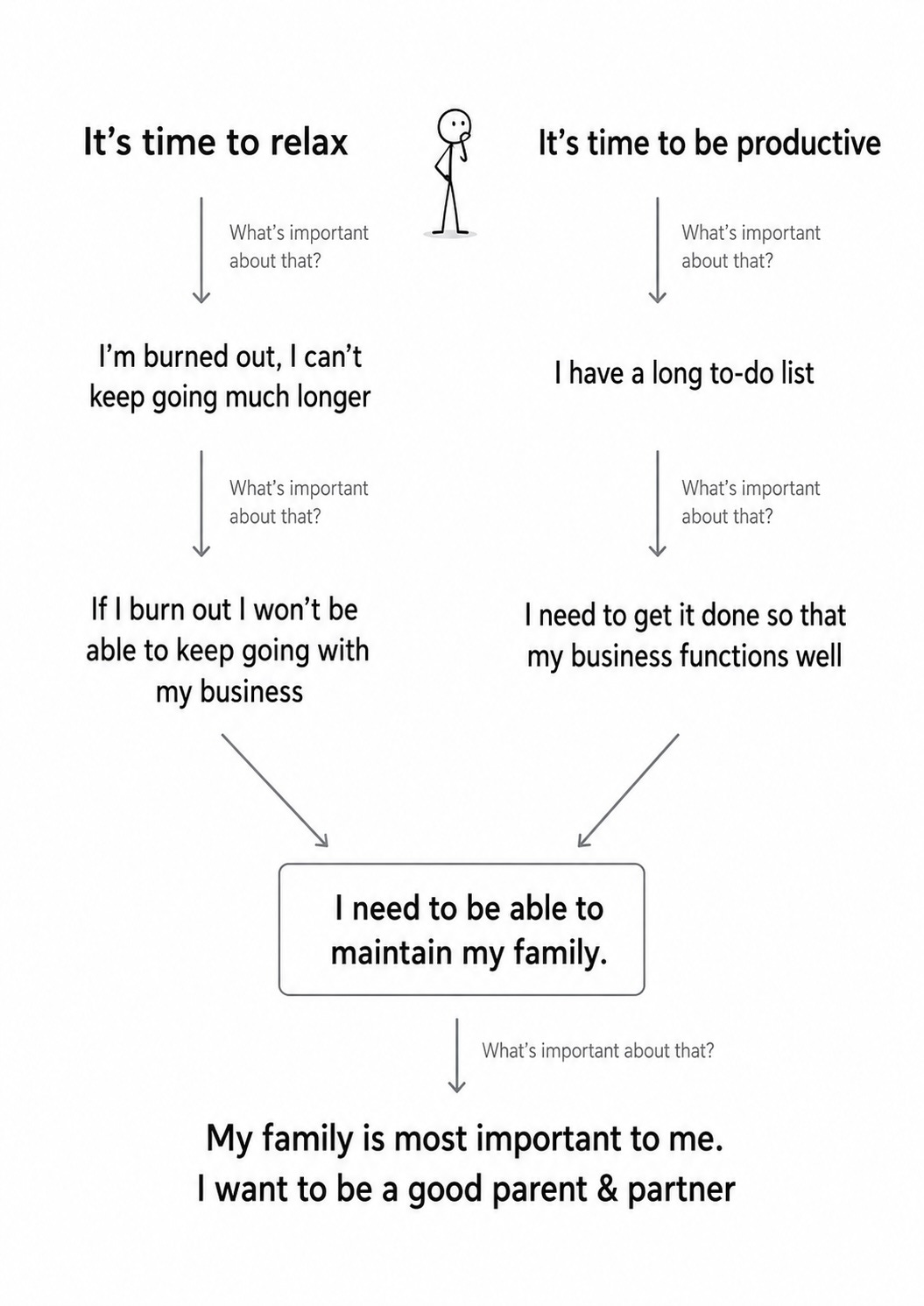
Doing this gives you a much wider picture of the situation. It’s much easier to recognise that if you crack on with your to-do list, you’re actually less likely to achieve your overarching goal. You’ve already been feeling fatigued and less productive and burnout is just around the corner. Additionally, you’re aware of the context. You’re on a family holiday right now. Spending time with your family helps you achieve your goals directly. You realise that most of your work tasks are not urgent, and this makes it easier to relax.
Of course this is an example. The context, perceptions, and goals will all be different each time.
In some cases, you may just need to experiment. Choosing one side always has some pros and cons. But dealing with the cons of one side is much easier than being affected by the cons of both sides as a result of staying stuck in the internal conflict.
Final thoughts
I totally recognise it’s often not that simple. We all hold beliefs that are not always logical. Many of them are unrealistic. They can help us achieve great things, but they can also make our emotions work overtime.
Being stuck in a chronic internal conflict is often the most problematic.
If you’ve tried different ways and things are just going downhill, it’s okay. You’re not alone. This stuff is hard. Stay in self-discovery mode where you can. Reflecting, journalling, and conversations about this topic can all help update something in your internal system.
Sometimes those unrealistic perfectionist beliefs are not easily accessible or may be associated with painful or traumatic memories. Seeking the help of a professional specialising in these issues could offer a good space to gradually get yourself unstuck from a lifelong battle with guilt.
If you’ve reached the end of this article, well done. It probably means the topic of relaxation being interrupted by guilt is familiar. It’s a long article. I feel a bit guilty for taking so much of your time. But just knowing it’s helped you, helps me feel less conflicted. 😊
👉🏼 Leave a comment. I put a lot of thought into this one. I’d love to hear what caught your attention.
Thank you for reaching the end of this article.
I’m glad you’re here :)

You might also like:


The article could not have come at a better time for me! The higher level value identification is such a helpful way to address that inner conflict. Thank you for writing this thoughtful piece 🙏
Amazing article and very nice