


No AI was used to write this article.
A couple of years ago, I bought a nice coffee machine, and I’ve been practising my latte art skills since. I started serving my guests a fancy speciality coffee with a white blob on top, which I bravely started calling a rosetta.
Their choice of drink was easy. They’d just say:
“Can I have one of those nice coffees of yours?”
Then I’d spend five minutes pretending to be a virtuoso barista whilst heavily exploiting my Gaggia Classic, all to produce their tasty drink.
Not a bad routine, right? Well, recently, under a spell of creativity, I decided to complicate things. I created a fancy menu my guests could browse before ordering a drink. It contained all possible coffee options, from espresso and cortado to fancy mochas and lattes. I also added hot chocolates and a selection of speciality and herbal teas. What a beauty!
I was extremely satisfied with myself. Then I invited my first guests, and something felt off.
Saying yes always means saying no
As I watched them browsing the fancy menu, I was probably expecting to witness some kind of fireworks, but instead I saw signs of effort and disappointment on their faces. What just happened?
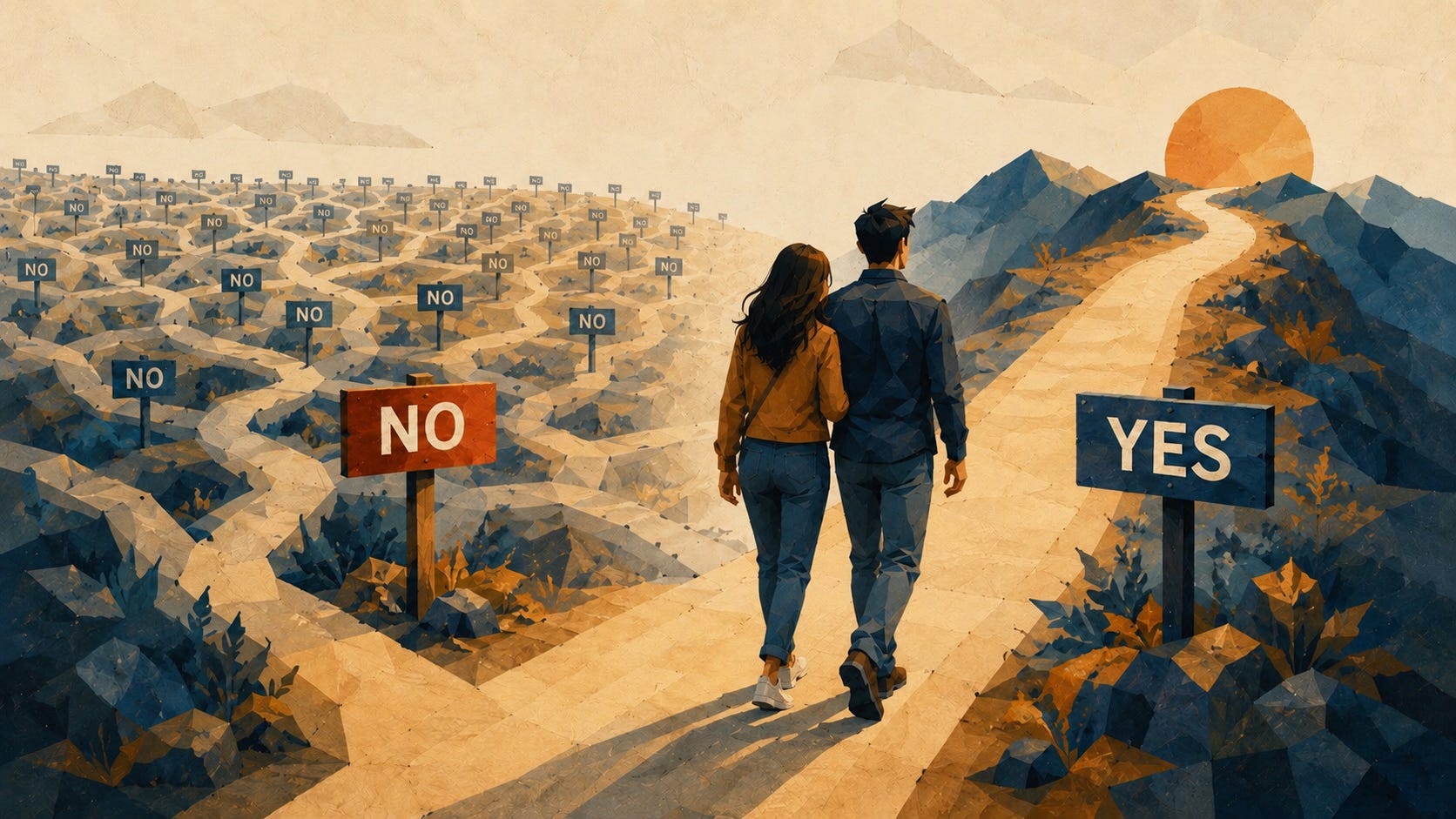
They were no longer excited about the lovely coffee I was just about to serve them. Instead, they were disappointed about missing out on all the other options. Previously, saying “yes” to a coffee meant guaranteed satisfaction (I’m being so humble!). Now, saying “yes” also meant saying “no” at least 25 times. Metaphorically, of course - I didn’t make them decline each option out loud! Although that would be funny.
This situation made me think. Every time we say yes, we actually say “no” multiple times. Sometimes, being aware of what we’re saying “no” to completely changes our perspective on what we have just said “yes” to. Sometimes for the better, and sometimes for the worse. I think there’s quite a lot to unpack here, but I’ll try to keep it simple. Let’s look at some easier examples first. Then we can move to some deeper reflections!
Saying yes and ignoring the no’s
I think the coffee example is quite trivial and, as with many trivial choices, sometimes it may be easier if we don’t know what we’re missing out on. Walking through a supermarket aisle offering towers of toilet paper options may push you towards decision fatigue, but, in reality, any of them would do just fine. Even the ones with printed strawberries would work fine, even if they make you panic that you have rectal bleeding.
Some of you may remember times when watching TV was easy. There wasn’t much choice out there. You’d just watch whatever was on. But now, you may spend 45 minutes browsing through all the options on Netflix, Prime, Disney and Apple TV, thinking, “What do I want to watch that would perfectly match my mood and energy?” By the time you choose, your cup of tea is cold. Worrying about missing out makes saying yes, and enjoying whatever you said yes to, much harder.
Every time you go to the gym, you’re saying no to swimming.
Every time you go for a run, you’re missing out on relaxing in the garden.
Every time you’re in a sauna, you’re not dancing, golfing or playing with your puppy. Usually, you’re okay with missing out. Dwelling on everything you’re not doing would probably ruin the experience at hand.
Saying yes and being aware of the no’s
What about serious decisions? Moving to a different country, changing jobs, buying a dog or getting married? All of these may require a bit more thought.
I must admit, despite being quite a reflective guy, I haven’t consciously thought about many of the “no’s” I invited into my life. When I was 19, I moved from Poland to England, and I was more optimistic about this choice than Jim Carrey in the film “Yes Man”. I started grabbing opportunities in life. I was lucky enough for this choice to work out for me and open up many fantastic opportunities. But it came with many “no’s” I hadn’t fully considered at the time, many of which only became apparent 15 years later.
Similarly, I always dreamt of becoming a therapist, but I hadn’t considered that this would probably mean saying “no” to my previous lifestyle. Sitting in an armchair for a few hours every day wasn’t part of it. I was always (and still am) a very active person. Sitting was quite low on my list of hobbies. I love being a therapist. Whether or not this means making some sacrifices to my lifestyle, body and posture, I would probably still make the same choice. That’s quite a lucky position to be in, and I’m grateful.
Are you making a choice or simply ignoring other options?
Sometimes saying yes without considering every alternative works out very well. When we say “yes”, all our attention is on what is in front of us. The thing we’re inviting into our life is more important than the thing we’re declining. We like what we see. We ignore what we don’t see.
I wanted to be a therapist. I wasn’t thinking that I might miss out on being a vet or an electrician. When moving to England, I wasn’t thinking about missing out on a possible future life in the Seychelles.
Even with simple choices, this is often true. Are you going on holiday to Spain? Not much analysis is required to recognise that, by choosing to sunbathe, you’re also missing out on a hiking trip in Switzerland at the same time.
There may be a mild internal conflict, but we resolve it quite quickly. There is no need for therapy, analysis, meditation space or a spiritual guru to direct us.
Unexamined choices, big conflicts
Things get much more complicated when we make impulsive choices about more serious decisions. Ignoring other options or pretending they don’t exist can create a long-standing internal battle.
Imagine you have a dream of a future where you cuddle up on a sofa with your partner and a cute dog every night. Buying the first cute and cuddly-looking puppy you see could set you up for 15 years of problems if the breed you choose is inconsistent with many of your other goals and circumstances, such as your health, finances, activity level, available time and willingness to commit.
If you look around, you constantly see people living with regrets. The wrong house. The wrong job. The wrong relationship. It’s not so easy to reverse some of these choices. These kinds of situations can happen because people said yes, but perhaps even more because they also unknowingly said no to something else. It would be a disaster to commit to a well-paid job only to realise, a few years later, that you had missed out on the career opportunity of your dreams.
Saying yes means commitment. Commitment gives our choices meaning.
When you have a good understanding of who you are and what your goals and values are, saying yes has a completely different flavour.
Instead of missing out, you’re adding meaning.
Let’s take getting married as an example. It’s an important decision. But impulsively saying “yes” to the first person who sparks your interest is a gamble. On the other hand, if you take part in a process of self-discovery whilst getting to know your partner, building memories together and connecting with a shared vision of the future, it makes the whole thing completely different.
Suddenly, saying “yes” to the person you love becomes beautiful. Doing so, of course, also means saying “no” to other potential partners, but this is exactly what makes it special. Your relationship moves to the next level. It was already very special, but now you’re committing to making this relationship a more official part of your vision and identity.
In this case, saying yes can reduce the potential internal conflict. You are making a conscious choice, and you can enjoy it. Suddenly, your life feels more on track. You have a sense of direction. There is less noise. You’re committed.
Being consistent with your goals
I planted a few pumpkin seeds in early spring. My original thought was that I’d grow the biggest pumpkin in the country. But this process was full of “no’s”. I had to give up on planting them in the ground so that the hungry slugs wouldn’t eat the seedlings. Planting them in pots already meant limiting their growth.
But I recently found out that the best way to grow a giant pumpkin is to cut off all but one of the lovely, healthy pumpkins the plant has produced. This allows all the nutrients and energy to help the one remaining pumpkin thrive.
Would keeping all the pumpkins and seeing them grow only to the size of tennis balls make the whole process worth it? Or would killing all but one of them just to grow one giant pumpkin be more meaningful?
Despite this being quite a trivial example, the answer is not so obvious. Only by digging a little deeper into my original goal can I make a decision. I planted the seeds because I wanted to challenge myself to grow a super-large pumpkin. Growing mediocre ones doesn’t sound that exciting. Sacrifices will have to be made. But if it works out, be ready to see me on the news, standing next to the biggest pumpkin in the world.
Final words
The most meaningful things in life happen because we say yes. However, committing always means rejecting other possibilities. Every time we say yes, we also say no.
You are where you are because you rejected being elsewhere.
You do what you do because you rejected other options.
Sometimes by chance or luck, and sometimes by choice. Our lives are formed by individual yeses. Each one of them carries countless no’s. By choosing where to direct your attention and resources, you decide what really matters.
Thank you for saying “yes” to reading this article
I’m glad you’re here :)

You may also like:


I'm publishing a piece this week that's closely related to this! In psychology this phenomenon is called the paradox of choice - how having too many options makes us less satisfied with the choice we make because we think about the other attractive options we're missing out on. And to your point about commitment: when a choice is irreversible, it tends to make us feel more satisfied with the choice that we're "stuck with". A really interesting example of how our mind works that goes against the intuition that more choice is always better.
I can relate to the coffee menu. Too many choices actually irritate me. I liked how you took something that simple and tied it into a bigger point.