


When I was a tennis player, we regularly ran to prepare for long tournament matches.
I remember one of those runs quite well.
I was about 12. The group consisted mainly of older and more experienced players. Some were preparing for junior national championships. I was one of the youngest. We ran through the local fields just outside Warsaw, led by our general conditioning coach, one of the kindest people I know.
My life was very busy then. Fitting these workouts between school and tennis practice meant a very tight schedule. I often arrived home from school with only 8 minutes to spare. My parents’ challenge was to feed me a nutritious dinner in this time.
On that day, time was short. My dad prepared a full plate of his signature dish: sliced, fried potatoes. In full Polish fashion I topped it up with a glass of kefir, a fermented milk drink.
You can probably guess where this story is going.
I was in the middle of a field, running with a group of over twenty players. They were keen to keep a good pace. But the only thing I was keen on was finding a toilet. And no toilet was in sight.
I came up with a plan. I quietly ran towards our coach to explain: “I have some pain in my abs. Maybe I pulled something. You can all keep going, and I will slowly make my way back.”
This backfired. What my coach did next was one of the hardest acts of kindness I’ve ever received.
He stopped the whole group for me. He mentioned something about team mindset and announced a 5-minute break for everyone. Instead of a silent escape, I had over twenty pairs of keen eyes staring at me. Lads and lasses, all ready to offer support, but also very keen to keep going.
My “injury” suddenly got better very quickly. We restarted the run and I reassured everyone that I was fine.
Thirty seconds later, I turned around and sprinted away to the local forest without a goodbye.
It is a funny story now. I think about it whenever I think about kindness. My coach was trying to help me, but his kindness made my problem much worse.
When kindness goes the wrong way
I really like analysing examples where good intentions have gone wrong. They show the gap between what the helper was trying to do and what the other person actually needed. A few examples come to mind.
Holding the door
A person holding the door for you when you’re still 20 metres away is doing it to be kind. But now, instead of having a relaxing morning, you have no choice but to perform a little jog. The person meant well, but their kindness has turned into your social obligation and an unintended cardio session.
A drink conundrum
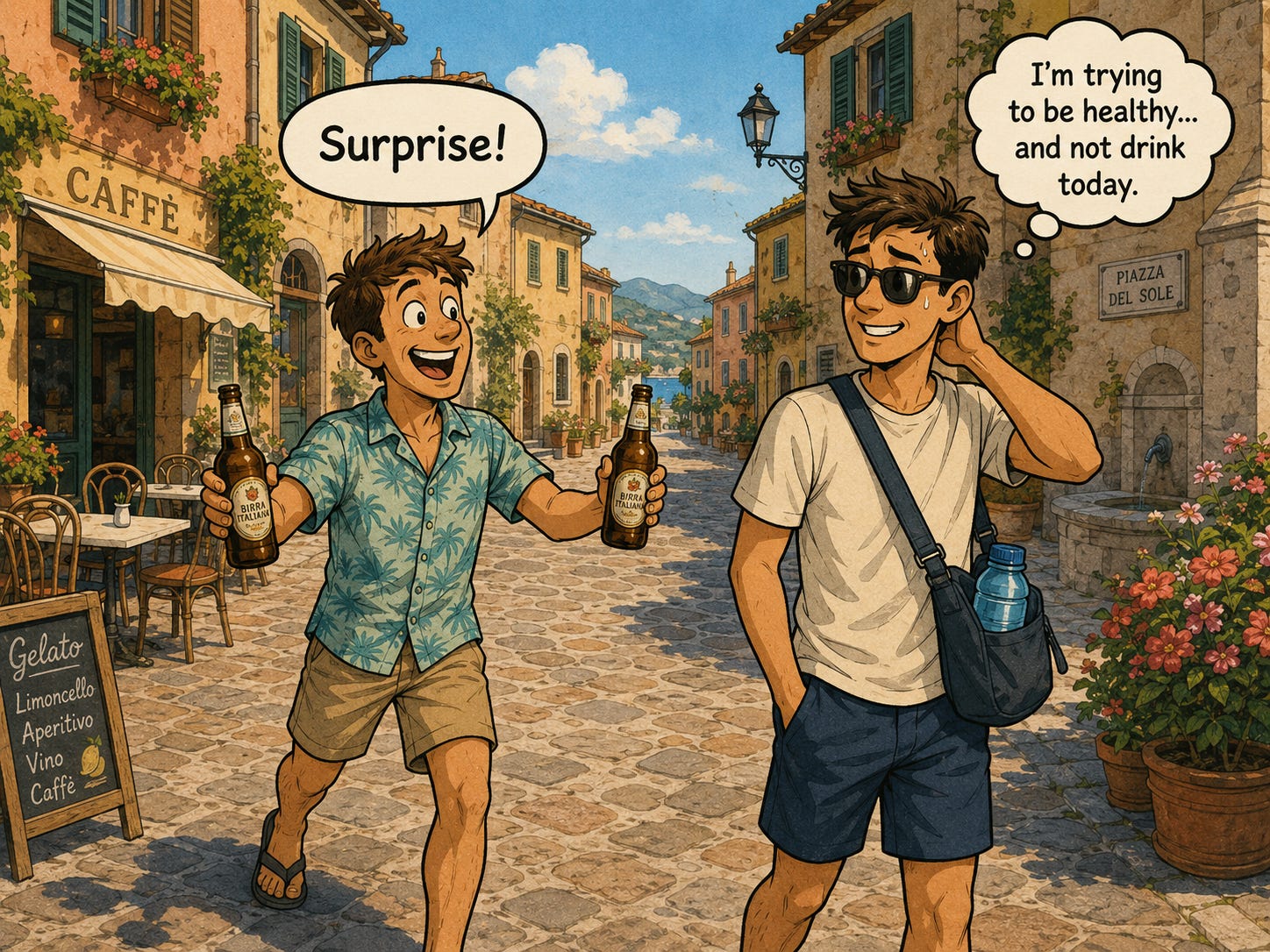
It’s a sunny day. You’re enjoying exploring a local town with your friend. You sit down to take a break, and your friend surprises you with a refreshing beer. They look very pleased. The only problem is, you have proudly managed to take a break from alcohol for 3 months. Do you disappoint your friend, ruin their smile, and then awkwardly watch them consume two beers while you wait for them to finish? Or do you accept the drink and quietly break a promise you made to yourself?
Children’s enjoyment
A famous 1973 study examined children’s enjoyment of drawing. Some children who already enjoyed drawing became less interested after they were offered rewards for doing it. The adult intentions were good, to encourage them. But the original interest was replaced by a chase for reward and approval. A kind attempt to motivate ended up reducing the thing it was trying to encourage.
Water aid
Finding and collecting water is a serious problem in some parts of the world. Building wells to support local people sounds like one of the kindest gifts. And in many cases, I imagine it is. However, many well-intended projects can create unexpected problems because outsiders misunderstand local customs and social routines. I’ve heard stories where building a local well had some negative consequences because long walks to collect water had also been a place where women exchanged information, socialised, and had some privacy from men. Access to clean water clearly matters. But it is a reminder that even obviously helpful ideas can go wrong when we don’t understand the world we are stepping into.
The cobra effect
There is also the famous “cobra effect” story from colonial India. The British government supposedly tried to reduce the cobra population by offering rewards for dead cobras. According to the story, people started breeding cobras for the reward. The historical details are disputed, but as a metaphor, it shows something useful: when we try to help without understanding the system, we can accidentally create the problem we wanted to solve.
Offering advice
We’ve all been in situations where we have the best intentions offering advice to a loved one. We know the solution. We can see it clearly. All we need is to help the person implement it. But all we hear back is: “Stop telling me what to do.” It can feel confusing. We were only trying to help. But from the other person’s perspective, advice may feel like pressure, criticism, or a sign that we are not really listening.
I can see new examples of this problem almost daily. Last week, I encouraged my friend to try an exercise on a pull-up bar that he probably wasn’t ready to do. He fell and hurt himself. Good intentions. Bad outcome.
Have you got a good example of kindness going badly? Share it in the comments.
Guessing another person’s needs
The examples above show that sometimes what we call kindness is an awkward attempt to match another person’s needs with our own ideas of what is helpful. We assume kindness is about what we are offering, forgetting about the most important thing: the needs of the person we’re helping.
This problem is everywhere.
Governments create financial incentives to support people on low incomes, but sometimes the benefits are captured by landlords, companies, or people who were already better off.
Parents try to give their children a stress-free life, but sometimes this shrinks their comfort zone and makes them more anxious.
Teachers encourage students with overgenerous grades, but sometimes this leaves them unprepared for university or work.
Grandchildren take over their grandparents’ physical tasks, meaning to be helpful, but sometimes this reduces their sense of independence and removes essential exercise from their day.
I could keep going.
When help becomes too helpful
The example I notice most often comes from my work as a therapist and supervisor.
Many novice therapists can feel pressure to be useful quickly. They may reach for techniques, worksheets, exercises, coping strategies, or advice. I have known therapists who come to work with a suitcase full of worksheets and materials they can share with clients.
Tools can be useful sometimes. But I have seen therapists become so focused on finding the right worksheet that it has become a distraction from offering real help.
Most mental health problems are more complex than they first appear. I often find that the more solutions a therapist offers, the more disappointed and misunderstood the client can feel.
This can happen in practical therapies such as CBT. Other approaches, such as Person-Centred Counselling or Method of Levels Therapy (MOL), move in a different direction. They help the person notice, explore, and understand their problems without advice or suggestions.
Practical support is sometimes needed, but even the best technique can become another version of holding the door open from 20 metres away.
Kindness through their eyes
I love the fact that there is so much kindness around us.
We see it, offer it, and receive it.
But I think a lot of kindness could work better with a small pause.
What does this person actually need?
Can I ask them rather than guess?
Can I offer something that fits their world rather than mine?
Kindness should be an intentional attempt to make someone’s life better by their standards, not ours.
Maybe that is the small experiment to try today with someone close to you. Pause before helping. Get curious and try to understand what the situation feels like from their side.
Then offer something that belongs in their world, not just yours.
Thank you for reaching the end of this article.
I’m glad you’re here :)

You might also like:
I Tried a Dopamine Detox. Then I Got Excited.

A few months ago I tried doing a dopamine detox. No coffee. No loud music whilst exercising. No YouTube. No social media. No podcasts while driving.
By day three, I was already noticing some...
Stress Is Good for You. Kind of.

The strange world of hormesis, resilience, and why stress can train us or drain us, depending on dose, meaning, and recovery.
Is Afternoon Coffee Bad for You?

Reflections over a flat white on caffeine, sleep, and conflicting life goals. How much does it help? How much does it cost?
I Became Obsessed with Cold Plunges. Here’s What I Learned.

What six years of experimenting with cold water taught me about stress, dopamine, and recovery - and the lessons I wish someone told me before I started.
Why Rest Can Feel Harder Than Work

Why stopping can feel tiring, even when it is exactly what we need.
Hey Kuba, stumbled across your account, this article was fun!
I write about AI adoption and you actually got me thinking how the tech bros, with their LLMs and AI tools, are making it a point to make our lives „easier” and „more productive”.
The products promise to give us time back, where in fact everyone seems to be busier and more stressed than ever.
Every chat ends with a kind offer to check, build or provide something more. Every AI agent is meant to take something off our plate, when we’re not even sure we want it.
Quite a fun read! Humor and comedy are indeed clever. hard to keep a shield up while laughing.
As for the essence, I absolutely agree; I'm particularly familiar with one side of it, the "fixing everything" one.
A kid comes and asks his friend, "I have these two candies, but I'm not sure which one to eat first." - His friend then takes them and grabs them so naturally that it just "happens," and, while chewing, says, "I don't understand; that wasn't that hard. They were equally good."