


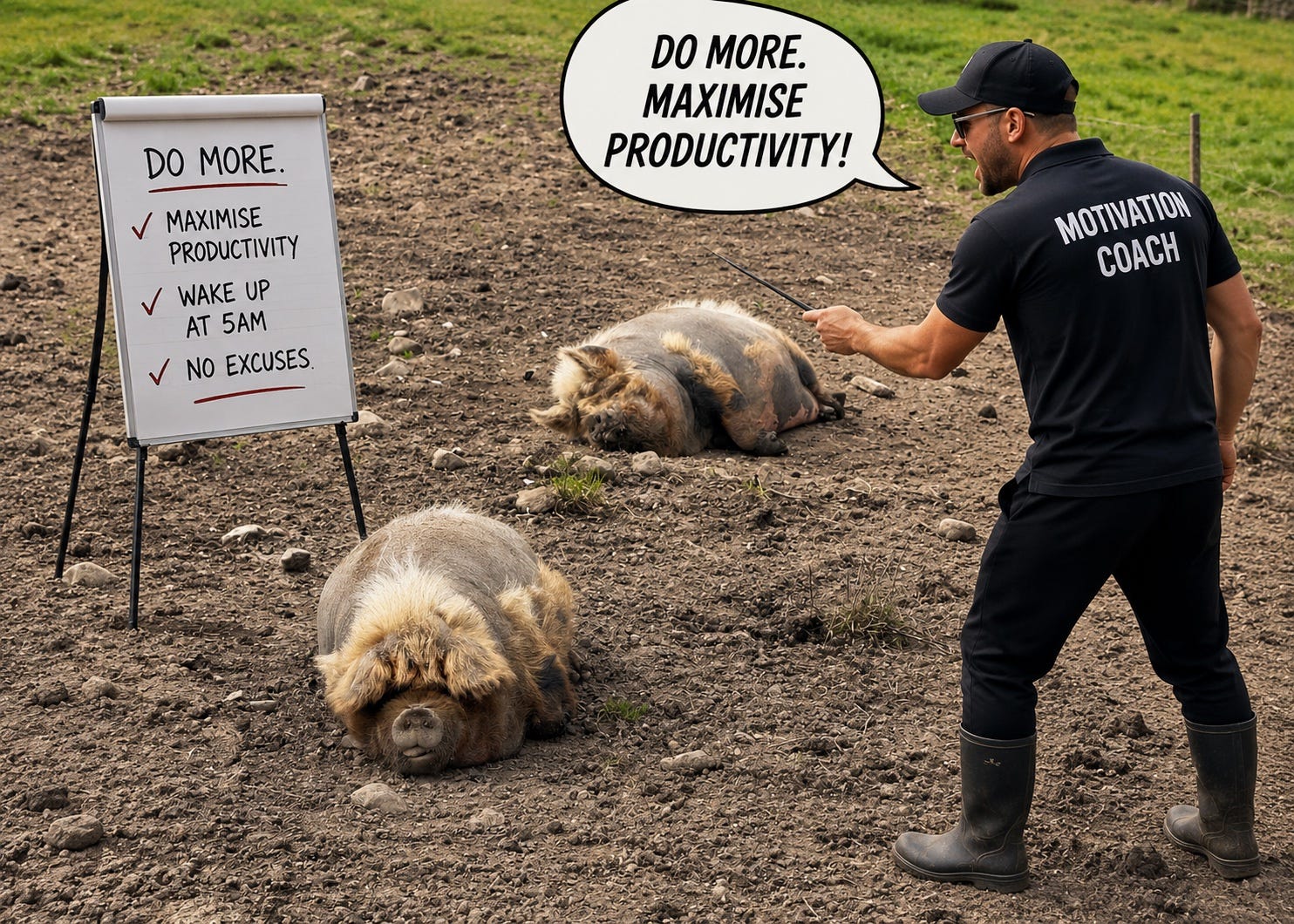
No AI was used to write this article.
I went to the gym this morning. I was aiming for a gentle session. Just me, the weights, some gentle movement and… wow, that’s probably the biggest mirror in the world. In its reflection I see people compulsively flexing to check their progress between sets. I look away and remind myself of my goals: Just lift and chill.
Unfortunately, my flow state doesn’t last long. Right in front of me I see a massive neon sign:
BIGGER!
BETTER!
STRONGER!
I stare at it for about 10 seconds. I just wanted to ignore it and move on. But I couldn’t stop thinking about it. They totally missed my goals! I don’t want to get bigger, better, or stronger today.
I can’t help but notice a lady focused on a demanding cardio session. I highly doubt that she’s there to get bigger. There’s also a slim man wearing a “London Marathon Finisher” T-shirt and completing some rehabilitation stability exercises. They missed his goals too.
This turned into a much bigger reflection. I started thinking about self-help books, therapists, coaches, trainers, YouTubers, TikTokers and other sources of information. People love sharing motivational messages and advice. They may have good intentions, but very often they miss the point.
Of course, it’s impossible for a sign to reflect multiple people’s points of view, so its designer tries to target the majority.
Advice for all
The first problem with advice is that it’s often directed at everyone. The author has gained extensive knowledge of a certain subject. They have figured out how something works. It’s only logical to start telling others about it. Unfortunately, this often rests on the assumption that we’re all the same. The advice typically goes like this: “You’re doing XYZ wrong; you must change ABC.”
Because such advice may be driven by their expertise in a given subject, it sometimes works for some people.
Similarly, the motivational neon sign in the gym telling me to get bigger is probably consistent with many gym attendees’ goals. I don’t think there’s that much wrong with it being there. It’s quite cool. But it’s one obvious example that motivational speakers, advice-givers and people designing wellness spaces all have something in common. They try to help the majority of people. Therefore, advice is often designed for a “typical” person attending the gym.
Books, TikToks and even research papers often describe what works on average. That can be useful, but it does not automatically tell us what will work for one particular person.
Advice for one
Sometimes the problem is the opposite. The person giving advice is a rebel. They tried the generic advice without any success. This was followed by some experimentation with alternative solutions. Eventually, they found something that worked for them.
Because their miracle solution is either simple, unusual or counterintuitive, it feels like a great discovery. The person shares it with the world through TikTok, YouTube or Substack articles. Some popular books suggesting solutions for mental health problems follow a similar pattern. The author may have valuable lived experience but no clinical training, yet still feel confident suggesting their solution to resolve other people’s mental health problems.
Unfortunately, it’s common for the exciting solution that seemed to work for them not to work for other people. The truth is, we may not even know whether it caused the change for that person. There are simply too many factors at play. They tried hundreds of tools with no success, so they assume that the one they were using when they got better must have been the one that worked. A complex psychological, physical, physiological or even spiritual change is condensed into the one visible tool or technique that is easiest to identify. Something that was vaguely correlated with the change becomes the explanation for it.
In other words, their advice takes the form of an ultra-compressed autobiography.
Sometimes, they ask you to reject conventional wisdom and follow advice based on what is essentially a retrospective correlational study with a sample size of one.
The “passionate people” trap
Despite years of studying psychology and even being involved in some scientific research projects, I constantly fall into the trap of “listening to passionate people”. And I think we’re all vulnerable. Watch a Netflix documentary, a YouTube video or listen to an expert on a podcast, and you suddenly start questioning your life choices.
Pick any topic. Find a person passionate about it. Then immerse yourself in a few of their videos or books. Their excitement and passion are contagious. It’s hard to resist becoming a follower of the trend.
Cold plunges, keto diets, intermittent fasting, calisthenics, bodybuilding, vegan diets, juice fasts, high-protein diets, mindfulness, barefoot walking, whoop lovers, whoop protesters, coffee lovers, zero caffeine, wine lovers, zero alcohol, nose breathers, intentional hyperventilation breathers…
Should I keep going?
…morning ritualists, biohackers, one-meal-a-day groups, Reiki masters, mediums, entrepreneurs, anti-ultra-processed-food campaigners, eat-what-you-want life enjoyers, hallucinogenic drug enthusiasts, “chemical-free” beauty products…
More?
…organic food eaters, passive investing experts, natural eyesight-healing methods, Hyrox lovers, minimalists, productivity-system fixers, money-saving experts, gut-healing enthusiasts, longevity experts, natural teeth-whitening methods, attention-span fixers, 9-to-5 lifestyle abandoners, early-retirement planners and so on…
I could keep going.
All that needs to happen is for you to accidentally bump into one of these passionate people on the internet. If what they talk about resonates with something in your life, you’re vulnerable.
Before you follow any advice
Okay… you’ve found an amazing new piece of advice and you’re ready to implement it. You’re just about to change your life. You’re excited. Great! But… wait.
Pause, reflect and do some research.
One approach I find useful is to spend some time looking at credible evidence and arguments for the opposite strategy.
You’re just about to start a keto diet? Fine. But have you looked at credible arguments against it? At accounts of people who tried it and hated it? Or even at evidence of possible health risks for some people?
Another thing to consider is whether this advice is actually consistent with your life goals. Is it helping you achieve what you want to achieve? Or is there a chance it’s getting in the way of other things you value?
Why should we be careful with generic advice?
We have already established that much of the advice out there has limitations or biases. It often assumes we’re all the same or tells us to follow one person’s story. But there is a deeper psychological explanation for why we should be careful with advice.
Any positive change we experience is much more complex than it seems.
Whether you’ve experienced a life-changing psychological transformation, improved your health or fixed a common problem, it’s unlikely that you can capture the exact process behind this change.
One scientific theory, known as the Perceptual Control Theory, proposes a hierarchy of 11 levels of perception, from basic sensations to higher-level concepts, including goals, values, and aspects of identity. The model suggests that what looks like one simple problem can involve many interconnected levels of experience.
A simple situation or problem may feel obvious, but it is deeply individual. In fact, I would be ready to risk the idea that your problem is one of a kind. It is unlikely that anybody else has experienced this exact issue in precisely the same circumstances, with the same feelings, sensations, personality and perception of the world.
This is the case for psychological problems, but also health problems, lifestyle problems, work problems and spiritual problems. Whatever you’re going through is different from what other people are going through.
Does it mean you should never listen to any advice?
The fact that we’re all unique doesn’t mean there is no value in sharing information. I just think we need to be careful with it.
I think you should even be careful with the advice in this article.
Reading books, listening to podcasts and watching educational content can all be useful. I just think it’s important to approach them with a pinch of suspicion. Here are some questions that sometimes help me:
“This was exciting. I’d love to try it. But is there a chance I’m falling into a trap?”
“This person sounds excited and passionate, but does it mean they’re right?”
“Is the person presenting an objective view of the world or just a one-sided and biased perspective?”
Final words
I think generic advice can be helpful at times. Many problems we face are also problems other people face. If something helped them resolve it, I’m interested in learning about it. It could help me too.
But I think other people’s ideas should be treated as additional prompts. Options. Perspectives.
Being well informed is great. Reading, watching and observing can gradually help you build your own knowledge base. Over time you build a more objective view of the world. Or perhaps a subjectively objective one, but at least it’s yours.
Thank you for spending a few minutes here :)
Here are a few more pictures of the cute woolly pigs featured in the article’s cover image. I spotted them during my trip to Wales a few weeks ago.


Keep reading:


Just finished this and it hit a bit too close.
That gym sign story was perfect. I’ve had the exact same moment where some motivational nonsense completely clashes with what I actually walked in for. The whole advice for the average person vs one guy’s miracle fix thing felt real. Especially the passionate people trap… yeah, I’ve fallen for that more times than I care to admit.
Yeah, I enjoyed this one. It's so easy to forget that what works for one person may not work for another. Everyone's situation is a little different. We should consider the advice but still think for ourselves. The woolly pigs are cool!