


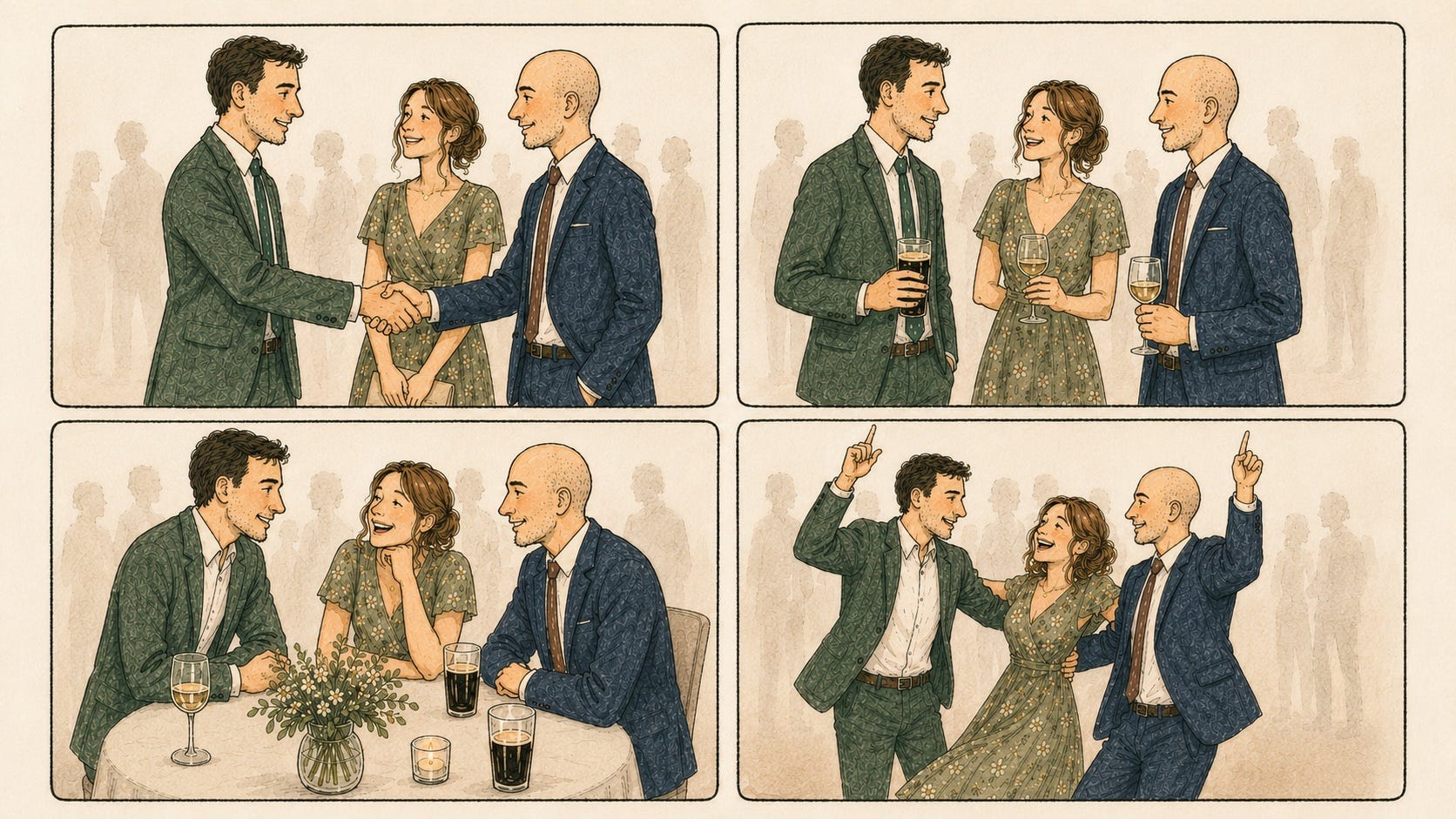
Last week I was in Ireland for my close friends’ wedding. Three days of celebrating, socialising, and dancing felt like a reset for my whole body. I came back refreshed, despite my body clock being completely dysregulated by sleep deprivation.
It’s interesting how much can happen in a few days, but even more intriguing is the fact that, in such a short time, I made friends with more people than I have in the last few months.
There are a lot of psychological angles you could take from events like this. I do have a tendency to try to cover too much in my writing, so let’s focus on one intriguing concept today. The power of temporary communities.
The power of temporary communities
It’s interesting how a stranger can start to feel familiar much quicker when they share the same space and story. Have you ever thought about how you met your close friends? Many friendships start in similar circumstances, first day of school or work, or maybe as a result of shared interest, experience, or goal.
In the last few days, I joined a group of people who had the same goals as me: celebrating, supporting the wedding couple, socialising, and enjoying ourselves.
People are unlikely to arrive at events like this with the goal of “I want to be alone” or “I want to avoid making any new friends”.
We kind of instinctively know this, and not much analysis is needed.
When we have a shared goal, connections happen much quicker. You’re able to walk across the room, approach a stranger, smile, say hi, and introduce yourself. It’s very likely you’ll experience kindness, openness, and interest back.
Doing the same to a random person on the London tube is unlikely to lead to the same outcome.
Saying hi to other guests opens the door to something new coming into your life: an interesting fact, funny moment, or cultural insight.
I had a conversation about tractors with the father of the bride, exchanged some wellness tips with a person currently staying in Dubai, and spoke to an ABBA fan who has seen the ABBA Voyage show nine times already, inviting me to join them next time.
At some point, a friendly guy approached me with a big smile on his face, congratulating me on my marriage, as he had mistaken me for the groom. I had to disappoint him by saying I was only one of the groomsmen, but we laughed about it a few times throughout the night.
Joining and leaving communities
We all belong to various groups and communities. Some of them are more exciting than others. And they all have certain social rules. Let’s have a look at a few examples.
Visiting the gym means you unintentionally join the “local gym community”, and you end up following its unwritten social rules. Put the weights back after use, respect other people’s space, etc.
When you attend a conference or mandatory training course at work, you join the “attendees” group. You try to arrive on time, exchange ideas with colleagues next to you, and may even suggest going out for lunch together, despite only just meeting some of them.
When I arrive for a game of padel, I usually play with people I’ve never met. But we’re all following the same rules, not cheating, and usually aiming to enjoy the game. People are very respectful of each other. We all become a group of friends for the next 90 minutes.
All these are examples of temporary groups. They all follow completely different rules, allow us to see the world from a different perspective and make us step out of our usual social script. You would never invite a random person on the street to go for lunch together. You probably also wouldn’t ask a person standing next to you at a bus stop for their bench press personal best.
As you go through your day, you constantly join and leave temporary communities, neighbours, commuters, work colleagues, gym goers, social media scrollers, parents picking children up, sauna goers, Substack writers, etc.
Goals connecting people
Each of the above groups connects people in different ways. Connection occurs because they all happen to be in the same space, at the same time, with a shared goal.
Goals connect us. Not just in temporary communities. We all crave social connection and search for people we can relate to. We watch YouTubers who share some of our ideas, we spend time with friends who understand or support our lifestyle choices, and we marry partners with a similar vision of the future to ours. I am writing this article with the hope that my ideas will resonate with the readers.
Sharing a goal with others seems to be one of the most important ingredients for connection. Maybe this is because humans naturally think in terms of “us”. In the case of the wedding, the shared thought would be: “We’re the wedding guests.” This creates a few shared goals. Opportunities for connection come up.
But the beginning is not always easy.
Why does socialising feel awkward?
I really like thinking about caveman era to explain how humans function. Many of our basic social tendencies make more sense when we remember that humans evolved in dangerous environments, where the main goal was “to not die”.
Living in a dangerous world without electricity and surrounded by predators would have made safety a big deal. Belonging was important. Being excluded from a group could have been dangerous. That’s probably one reason why any sign of disapproval from others can make us feel down, and breaking social norms can lead to embarrassment. These emotions probably help us notice threats to our sense of belonging and help adjust our behaviour.
It may feel a little outdated, but it’s also true today.
Forgetting to wear my trousers to work would be a disaster. Luckily, just the idea creates a sense of embarrassment, preventing me from risking my social image.
Arriving at an event where we don’t know anyone can also feel intimidating. And for a good reason. You are joining a group of people, but you’re not yet fully familiar with the rules. Awkwardness and embarrassment are signals for you to be careful.
You don’t go into a monologue about why your way of loading the dishwasher is objectively correct. This would be random and risky.
Instead, you take your time to get to know the person, starting with safer topics.
How does awkwardness turn into temporary friendship?
In temporary communities, connections happen much faster.
But to achieve the effect of accelerated friendship, you may need to put in some effort first.
How does the same person looking away in awkwardness when you’re shaking their hand end up putting their arm around you and bouncing with you on the dance floor two hours later?
One way to understand this is through what psychologists often call the “mere exposure effect”. Its understanding has evolved over time, but the idea is still very relevant. People tend to develop a preference for things they are familiar with. So repeated exposure to the same object, situation, or person can result in developing more positive feelings.
It starts with a simple hello before the ceremony. From there, the connection deepens gradually → a smile as you pass each other → a conversation by the bar → bumping into them outside the toilet → dancing in the same corner of the dance floor → having breakfast together the next day → exchanging photos, and so on
Window of opportunity
At events like this, the window of opportunity never really closes, but it gets smaller.
The above repeated exposure effect means that each person is slowly building a “circle of certainty”. Entering the next stage of the wedding is much easier because there are already some familiar faces. People will naturally gravitate towards and approach the people they know.
This can accidentally mean excluding those they haven’t met yet.
That’s why I think it’s important to make an effort at the beginning of such events. A very small smile or handshake takes 10 seconds, but opens the door for the power of repeated exposure. Often leading to quite meaningful connections by the end, especially if the wedding includes more than one day of celebrations, which was the case for the Irish wedding I attended.
So why do many people not like weddings?
For many people, attending a social event is a nightmare. Anxiety, embarrassment, and worries can dominate the experience. If that’s you, please allow me to share some reassuring thoughts.
As much as most people’s goal is to “socialise” and “enjoy” themselves, that’s not true for all. There are plenty of people who go to such events with the goals of “survive” and “don’t stand out”.
If this sounds familiar, then remember that there are plenty of people who have similar goals. This may make you feel better. You can join the temporary community of “social survivors”. Finding them should be relatively easy, because they are likely to spend time in similar spaces, e.g. smoking zone, quiet side room, toilet, or beer garden.
You can build a surprisingly good connection by exchanging your ideas about awkwardness and shyness and even laugh at the awkwardness of these events.
At each stage of the event, seeing this person again will feel like safety and relief. Those positive feelings will help to build a good connection over time.
Taking advantage of the power of temporary communities
Temporary communities create shared rules and expectations, but this doesn’t automatically come with friendships. For example, in many gyms, the shared goal is to exercise while politely leaving each other alone.
For accelerated friendship to be an option, you may need to consider communities whose goal includes social contact.
A wedding does this very well. So does the first day at school or university. Starting a new job. Attending a training course. Moving into a new build estate where everyone is meeting their neighbours for the first time. Joining a retreat, sports trip, or group holiday.
In those situations, introducing yourself is kind of expected.
As you go through life, observe those moments when you feel a little awkward. It’s very possible that others share that feeling. And there it is. You found your shared goal.
Next time you attend a wedding, course, or another extended event, try to take advantage of the window of opportunity at the beginning.
Just saying hi to a few people early on can start a chain of repeated exposure.
Nothing impressive.
Just a smile, a handshake, or a quick introduction.
Then, when you see them again later, they are no longer strangers.
That’s often how it starts.
Thank you for reaching the end of this article.
I’m glad you’re here :)

You might also like:
Stress Is Good for You. Kind of.

The strange world of hormesis, resilience, and why stress can train us or drain us, depending on dose, meaning, and recovery.
I Tried a Dopamine Detox. Then I Got Excited.

Why cutting out stimulation can help for a while, and why treating dopamine like the enemy misses the point.
Is Afternoon Coffee Bad for You?

Reflections over a flat white on caffeine, sleep, and conflicting life goals. How much does it help? How much does it cost?
Your Kindness Could Ruin Someone’s Day

A story about good intentions, awkward help, and how kindness can backfire.
This was a nice read, @Kuba Grzegrzolka—I enjoyed the light, accessible approach you bring to human connection. I do wonder, though, how most people would tag a temporary friendship in those circumstances. I'd probably say most become acquaintances rather than friends.
Friendship feels increasingly elusive these days—optional, even, and in a transactional society, sometimes not needed at all.
Good read! I've seen the same thing happen at training courses. Shared goals have a way of bringing people together.